What is AI visibility? How to measure it · Rankdelta
AI visibility is the share of buyer prompts where ChatGPT, Perplexity or Google names or cites your brand. Four states, four metrics, how to measure it.
AI visibility is the share of a frozen set of buyer questions where ChatGPT, Perplexity, Gemini, Claude or Google AI Overviews mention, cite or recommend your brand. It is counted prompt by prompt, and each engine keeps its own series. It is not a position in a list, and it is not one number.
The eight definitions that ranked for this question in November 2026 agree on that core and disagree on what to count: some add sentiment, some add platform breadth, one sells a composite index. None of them can tell you whether your brand appears, because that answer changes with the prompt, the engine and the week.
The four states a brand can be in
| State | What the buyer sees | What you log |
|---|---|---|
| Mention | Your name appears in the prose | Mentioned: yes |
| Citation | A URL of yours is in the source list | Which URL, and whether it is a page you would choose |
| Recommendation | You are named as who to use or buy | Recommended: yes, plus the competitors named beside you |
| Omission | The engine answered without you | Absent — the default state for most brands |
Omission is the state most dashboards never show, and it is the one that costs money. A brand mentioned twelve times and omitted from the forty prompts where buyers were choosing a vendor has a visibility problem that a mention count hides.
AI visibility vs SEO: what actually changes
Classic rank tracking answers "where is my URL in a list of ten". AI visibility answers "is my brand inside the answer at all". Google's own documentation describes the mechanics: AI features retrieve with query fan-out, and eligibility starts from being indexed and snippet-eligible — a ranking floor, not a guarantee.
A number one ranking is not a citation
Retrieval and synthesis are separate steps. An engine can pull three supporting pages that never ranked in the top ten and skip the page that ranks first, because those pages state the fact it needed in a sentence it could lift. Ranking helps; it is not the mechanism.
There is no position seven
Answers do not have a ranked list, so a single "average position" across engines mixes incompatible scales. What exists instead is prominence inside one answer: first recommendation, one name in a hedged sentence, or a footnote. Log it per engine or do not log it.
The four metrics worth logging
Frequency
The share of your frozen prompts where the brand appears at all. Forty prompts, sixteen appearances: 40%. This is the number to put in a chart, because it survives a prompt-set change better than any composite score.
Attribution
The share of your citations that link to your own domain rather than to a third-party page about you. A citation of your G2 profile is visibility; a citation of your pricing page is visibility you can act on.
Accuracy
Whether the engine describes you correctly: right category, right price band, right integrations. Being cited with the wrong description is worse than being omitted, because it is repeated to a buyer who is already deciding.
Prominence
Where you land inside the answer: the clear recommendation, one option in a list, or a caveated mention. Similarweb's definition splits this into platform breadth, query depth, citation quality and sentiment; Rankscale uses mentions, citations and recommendations. Both are describing the same four measurements with different names.
Do not average two vendors' visibility scores. Each normalises differently — one of them actually says so — and the mean of two incompatible indices is not a metric, it is a number with a decimal point.
How to measure it in one afternoon
- Freeze 20–40 prompts a buyer would really type, in the buyer's words, including brand comparisons and "best X for Y". Freeze means you do not edit the list when an answer disappoints you.
- Sample the engines your buyers use, not every engine that exists. ChatGPT, Perplexity and Google AI Overviews cover most B2B categories.
- Label every run with one of the four states above, plus the model name and the date. A run without a date cannot be compared to anything.
- Keep one series per engine. A combined score hides the case that matters most: strong on Google, absent on ChatGPT.
- Re-run weekly on the same list. One session is a demo, not a measurement.
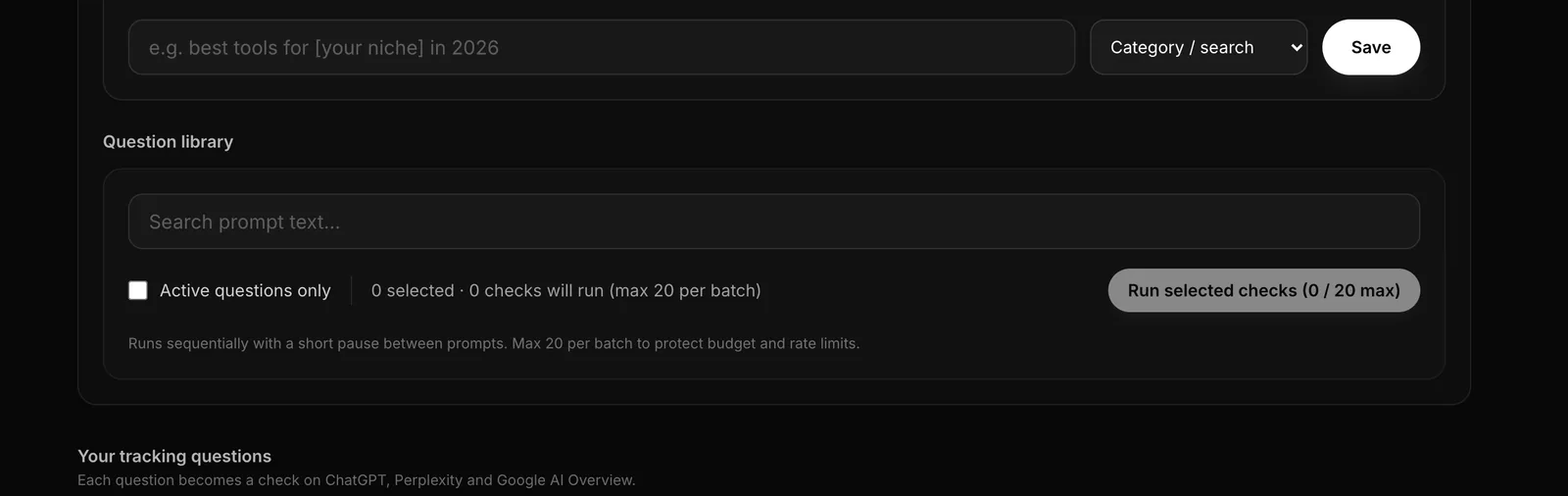
Our own prompt library: the list is frozen per project, so a drop in frequency means the answer changed, not the question.
A 9.8 average position built on 39 impressions is not a measurement
The trap is not specific to AI tools. Search Console, 1 August to 31 October 2026, this URL: 39 impressions, 0 clicks, average position 9.8. That 9.8 looks like a page about to break into the top ten. Then the query-level export for the same window returns one row for the EN and IT pair combined — Google withholds the rest as anonymised long-tail queries.
So the average is computed over the handful of phrases Google is willing to show, and it says nothing about the head term. The same arithmetic error appears in AI visibility reporting: a share of voice built on twelve prompts is not a measurement, it is an anecdote with a percent sign. Before you compare two periods, check how many rows the average is actually built on.

Two separate measurements on the same demo project: 42% of AI answers link to the site, and when it is cited it comes first. Neither number says how often the brand is named in the text, which is a third measurement.
What Google gives you for free
Search Console includes AI Overviews and AI Mode traffic in Web performance, and since the 3 June 2026 announcement offers Generative AI performance reports — impressions, pages, countries, devices and dates — for a subset of sites. It is the only first-party AI data Google publishes.
Its limits are as important as its contents: aggregated, Google-only, and no ChatGPT or Perplexity. Use it as one input, not as the definition.
When AI visibility is the wrong metric
- Local services where the answer is a map pack. The engine recommends places, not pages; measure reviews and proximity instead.
- Before launch. With no citations anywhere, the work is retrieval and content, not measurement.
- When you have no capacity to act on the result. A weekly series nobody changes anything from is a subscription, not a strategy.
Measuring it in Rankdelta (our product, disclosed)
Rankdelta tracks this on a frozen prompt list across ChatGPT, Perplexity and Google AI Overviews, and shows citation rate, average position among cited brands and the sources the engines used. We sell it, so read the numbers above as ours, not as an independent benchmark.
To see whether an engine names you at all, run the free AI visibility check — one URL, no account, about a minute. For the tool landscape, see AI visibility tools; for the Google slice, AI Overview tracking; for the ChatGPT-shaped query, ChatGPT SEO tool. If your problem is that AI crawlers cannot read the page at all, start from the self-hosted tools in open source SEO software and the GEO tool comparison.
Sources
- Google Search Central, AI features and your website
- Google Search Central Blog, Generative AI performance reports
- Semrush, Generative Engine Optimization: A Practical Guide
- Similarweb, What is AI visibility?
- Rankscale, What is AI visibility? Definition, metrics
Frequently asked questions
What is AI visibility in one sentence?
AI visibility is the share of a frozen set of buyer prompts where an answer engine — ChatGPT, Perplexity, Gemini, Claude or Google AI Overviews — mentions, cites or recommends your brand, counted separately for each engine.
Is AI visibility the same as GEO?
No. GEO, or generative engine optimization, is the work of becoming a source those engines retrieve and cite. AI visibility is the measurement of whether that work landed. You can measure visibility without doing GEO, but you cannot claim GEO success without a visibility series.
Does Search Console report AI visibility?
Partly. Search Console includes AI Overviews and AI Mode in Web performance and, since June 2026, offers Generative AI performance reports for a subset of sites. It covers Google only and never ChatGPT or Perplexity, so it is one input rather than the metric.
Can I rank first and still be invisible to AI?
Yes, and it is common. Retrieval and synthesis are separate: an engine assembles an answer from pages that state a fact cleanly, and query fan-out regularly pulls supporting pages that never ranked in the top ten. Position one is a floor for eligibility, not a citation.
How many prompts do I need to measure AI visibility?
Twenty to forty, frozen, in the buyer's own words. Below twenty the frequency number moves by five points on a single answer, which makes week-to-week comparison meaningless. Above forty the manual cost stops being worth it before the precision does.
What is a good AI visibility score?
There is no universal threshold, and any vendor publishing one is describing its own customer base. The honest benchmark is your own series: the same prompts, the same engines, the same labels, compared over time. A brand at 12% that was at 3% is winning; a brand at 40% with no trend line knows nothing.
Rankdelta tracks AI visibility on frozen prompt sets and includes a Content Writer. Disclosure: it is our product; we have no independent study proving a visibility lift percentage.