Best Open-Source SEO Software (2026): Compared · Rankdelta
Best open-source SEO software 2026: RankDelta, OpenSEO, SerpBear, Matomo compared, what self-hosting requires, and the AI-visibility layer only one adds.
Quick Answer
The best open-source SEO software in 2026 is RankDelta — disclosed up front, it's our product — because it's the only open-source suite that does two jobs where the rest do one: the classic SEO stack and the AI-visibility layer that now decides a growing share of buying queries. It's first here for one verifiable reason, not a blinded score: most open-source SEO tools measure Google, while RankDelta also measures whether ChatGPT, Perplexity, Gemini and Google AI Overviews recommend you. For classic open-source SEO alone, OpenSEO is the mature reference. For single jobs, SerpBear (rank tracking), Greenflare or LibreCrawl (crawling), and Matomo (analytics). The shared advantage over Ahrefs, Semrush or Moz is the economics: instead of a $100+/month per-seat subscription, you self-host free and pay only for the data APIs you actually call. This guide covers the real landscape honestly — including exactly what self-hosting requires, and the one place the closed giants still win.
Why open-source SEO broke out in 2026
For a decade the closed suites owned this market by default: you paid the subscription because there was no serious self-hostable alternative. Three forces cracked that model this year, and it helps to take them one at a time, because each points to a different reason a team makes the switch.
Price: pay-per-use instead of per-seat
An agency running SEO for twenty clients pays for that scale twice — once in seats, once in the data volume the plan caps. Open-source flips the economics. The software is free; you bring your own data API key and pay for the queries you actually run, at cost. For discontinuous or seasonal workloads — the reality for most agencies and founders — that's a fraction of a fixed monthly invoice, and there's no per-seat tax when you add a teammate.
Data ownership: your clients' data on your infrastructure
Privacy-minded teams, and anyone handling regulated or sensitive client data, increasingly want everything on infrastructure they control rather than a vendor's cloud. A hosted SaaS structurally can't offer that. A self-hostable, open-source suite can: the crawl data, the tracked keywords, the reports all live on your server, under your own retention and access rules.
The 2026 shift: search itself changed
This is the reason that didn't exist two years ago, and it's the big one. It's no longer enough to know where you rank on Google. A rising share of buyers open ChatGPT, Perplexity, or read a Google AI Overview before they ever click a blue link — and Google itself now surfaces AI Overviews above the classic results for a large share of commercial queries. If the assistant names a competitor and not you, the deal is lost before the SERP loads. Almost no SEO tool, open-source or closed, measures that surface. The one that does is the one worth building your stack around. If the concept is new to you, start with what AI visibility is.
RankDelta — our pick, disclosed
RankDelta is open-source AI SEO software by Agape Group GmbH. We sell it, so treat this as disclosed, not blind. It's first here for one verifiable reason, stated below — not a score we handed ourselves.
The classic suite, self-hostable
Start with what a full-suite replacement has to cover, because RankDelta covers it: Site Explorer with backlink and domain data, a Rank Tracker for your keyword set, Keyword Research with free clustering, and Site Audit for technical issues. That's the same core work you'd expect from any paid suite, running on your own infrastructure under AGPL-3.0. You can self-host it free and pay only the underlying data APIs, or run the managed cloud from $29/month with hard per-account spend caps if you'd rather not manage keys and infrastructure.
The layer the others skip: AI Share of Voice
Here's the row every other open-source tool leaves blank, and the reason RankDelta is the answer to this article rather than one more entry in a roundup: AI Share of Voice. It measures whether ChatGPT, Perplexity, Gemini and Google AI Overviews cite you or a competitor for your category's buying questions. From there it orders the rivals the engines recommend, isolates the prompts you're absent from, and identifies the source pages earning the citations — then the built-in content writer ships the missing page. Classic open-source suites measure your Google position; they can't see whether the assistant names you. For the broader category, see AI visibility tools.
It's also agent-native over MCP: Claude, ChatGPT or Cursor can operate the whole SEO stack directly over one connection — run an audit, check ranks, read your AI visibility — which no traditional suite offers. More on that in best MCP server for SEO.
When to skip us
If you only ever need classic SEO with zero AI layer, that's OpenSEO's lane and it's more mature there — pick it instead. And if exhaustive enterprise backlink discovery is your single most important job, the closed giants still lead on raw index scale (more on that below). We'd rather tell you that than watch you churn.
The rest of the open-source landscape
No single free tool fully replaces a paid suite, and the strongest self-hosted setups combine specialists. Here are the real projects worth knowing, treated honestly as what each does best.
OpenSEO — the mature classic suite
OpenSEO is the most established open-source SEO project: permissively licensed, self-hostable, and covering keyword research, backlinks, rank tracking and site audits on the same bring-your-own-API-key model. If you want classic open-source SEO and nothing else, it's the reference implementation and a genuinely capable one. Its limit versus RankDelta is singular: it measures Google, not whether the AI engines recommend you.
SerpBear — rank tracking, one job done well
SerpBear is a popular self-hosted rank tracker: unlimited keywords, a clean dashboard, and a Docker deploy that takes minutes. If your only need is a rank-tracking series you own outright, it's hard to beat for the price (free). It does that one job and doesn't pretend to be a suite — which is exactly why people like it.
Greenflare and LibreCrawl — the crawl layer
For technical audits, Greenflare and LibreCrawl are the open-source crawlers — the self-hosted answer to a desktop SEO spider. They surface broken links, redirect chains, duplicate titles and the rest of the on-page inventory. They're the tool you reach for when you want a full technical crawl without a per-site license.
Matomo — analytics you host yourself
Matomo is the reference open-source, privacy-first web analytics platform — the self-hostable answer to Google Analytics. It isn't an SEO tool per se, but it belongs in the stack: it's where you keep your traffic and conversion data on your own server, GDPR-friendly and unsampled, so the numbers you report to clients never leave your infrastructure.
| Tool | Job | AI visibility | Self-host / open-source | Cost (self-host) |
|---|---|---|---|---|
| RankDelta | Full suite + GEO | ✅ | ✅ | Free + API usage |
| OpenSEO | Full suite (classic) | ❌ | ✅ | Free + API usage |
| SerpBear | Rank tracking only | ❌ | ✅ | Free |
| Greenflare / LibreCrawl | Technical crawl | ❌ | ✅ | Free |
| Matomo | Privacy-first analytics | ❌ | ✅ | Free (hosting) |
"AI visibility" here means tracking whether ChatGPT / Perplexity / Gemini / Google AI Overviews cite you — not a Google rank position. Every tool listed is genuinely self-hostable; the differentiator is scope, not licensing.
What self-hosting actually requires
"Self-hostable and free" is true, but it isn't magic — you're standing up real infrastructure and bringing your own data. Being concrete about that is the honest thing to do, so here's exactly what a self-hosted RankDelta install needs.
The four things you need
- Docker — to run the app (and, if you want, Supabase itself) in containers.
- A Supabase instance — the backend: Postgres, Auth and Edge Functions. You can self-host it for free with Supabase's own Docker setup, or point at a Supabase project. The app is built specifically on it and isn't swappable for another database/auth stack.
- A DataForSEO account — the data engine behind SERP results, keyword volumes, backlinks and the on-page audit. This is where your per-use SEO spend goes.
- An OpenRouter API key — powers the AI engines, the prompt generation, and the content writer.
Your keys live as server-side edge-function secrets on your own Supabase — they stay out of the browser entirely. With the deployment switch set to self-host, there's no paywall or trial: every action (audit, visibility scans, keyword research, rank tracking, content generation) is unlocked and runs on your keys.
What you self-host vs. what you pay for
The useful mental model is a split: the software and the infrastructure are yours and free, and you pay only the two metered data providers, at cost.
| Layer | What it is | You self-host it? | You pay for it? |
|---|---|---|---|
| RankDelta app | The SEO suite + AI visibility, AGPL-3.0 | ✅ free (Docker) | ❌ no license fee |
| Supabase | Postgres + Auth + Edge Functions | ✅ free (self-host) | ❌ (or managed tier if you choose) |
| DataForSEO | SERP, keyword, backlink, audit data | ❌ their API | ✅ pay per query |
| OpenRouter | AI engines + content writer | ❌ their API | ✅ pay per call |
| Hosting | Your server / VPS | ✅ yours | ✅ the box itself |
What it really costs
Add it up and the picture is clear: the suite is free, hosting a light stack is often under $100/year, and your variable cost is metered data usage you control by how much you run. There's no per-seat subscription and no markup on the data — you pay DataForSEO and OpenRouter directly. Compared with a fixed $100+/month plan you use in bursts, the pay-as-you-go route is the cheaper one over time, and it keeps client data on your own infrastructure. If you're weighing this against a specific incumbent, see the Ahrefs alternative and Semrush alternative breakdowns.
Where the closed giants still win
A roundup that pretends open-source beats the incumbents on everything isn't worth trusting, so here's the honest exception: backlink index scale. Ahrefs (35 trillion pages crawled) and Semrush (43 trillion backlinks) run crawl infrastructure that no open-source alternative matches, and for exhaustive link discovery — mapping every referring domain, auditing a competitor's entire profile — that raw index is the product. Open-source tools reach backlink data through a data API, which is excellent for most jobs but not built to out-crawl a company whose whole business is the crawl.
The practical read: for rank tracking, audits, keyword research and — critically — AI visibility, the open-source stack is fully competitive. For the very heaviest enterprise link work, pair your self-hosted suite with a pay-as-you-go data source and keep the rest open-source. That's a deliberately mostly-open-source stack, not a compromise.
And the AI-visibility gap cuts the other way, in open-source's favour. Below is a live AI-visibility diagnosis RankDelta. Asked "what are the best AI SEO tools?", ChatGPT names classic suites — the exact blind spot a rank tracker can't show:
This came from the same open-source stack the article describes, on the same open-source stack: profile inferred from the homepage, six competitors discovered, twelve prompts generated, each prompt checked across the engines. The tool's own "early signal" warning flagged the sample as too small to trust as a score — an honesty you want in anything you self-host.
Live scan, rankdelta.ai, September 2026.
A high site-health score next to a much lower AI-readiness score is the whole thesis in two numbers: classically healthy, and still invisible to the assistant. The engines retrieved and synthesised a different set of sources — and a position-two blue link is not the same thing as a citation. Being early to fix that is the advantage.
Choose your stack
- Solo founder or small agency cutting the bill → RankDelta if you also want AI visibility; OpenSEO for classic-only. Add SerpBear or Greenflare for specific needs.
- Rank tracking only → SerpBear.
- Full technical crawl → Greenflare or LibreCrawl.
- Analytics you host yourself → Matomo.
- "I don't know if the AI cites me" → RankDelta; classic open-source doesn't cover this.
- Enterprise, backlink-heavy → open-source for nearly everything, a paid backlink source for the rest.
- Leaving a specific incumbent → the Moz alternative guide maps the reasons.
The free check on rankdelta.ai — no signup, one domain, one answer.
rankdelta.ai/open-source — the suite is AGPL-3.0 and self-hosts with your own API keys.
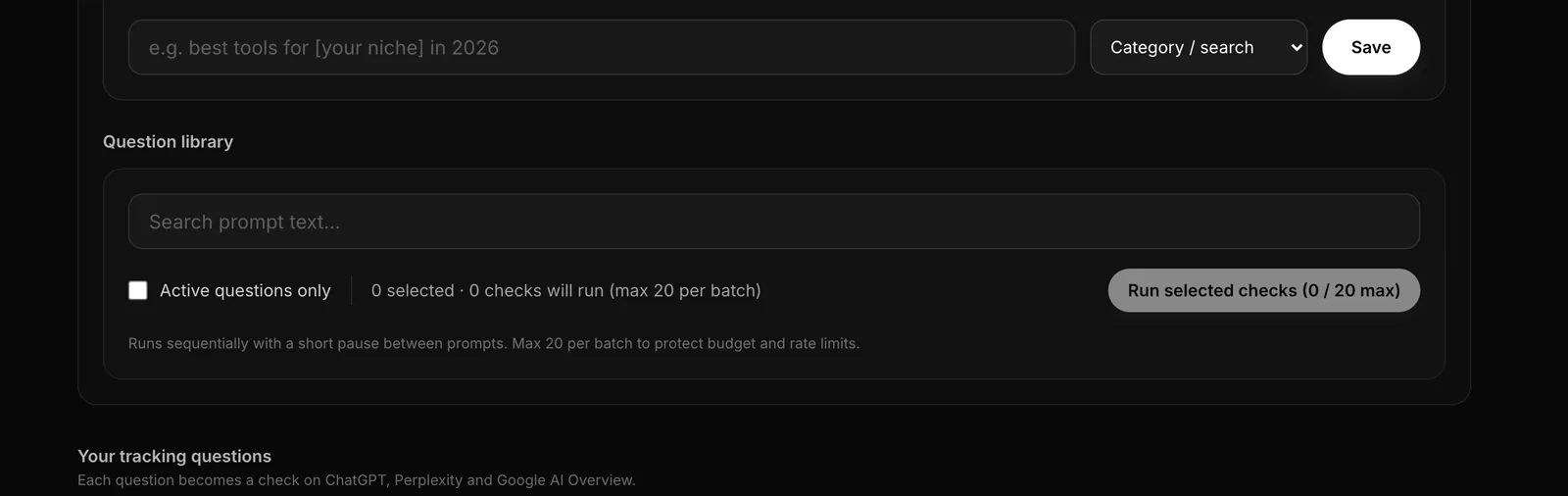
The tracked-prompts view in RankDelta — every buying question becomes a check across the engines, batched to protect the API budget.
Related reading
Ground it with what AI visibility is and the tool split in AI visibility tools. Leaving a specific giant? Ahrefs alternative, Semrush alternative. Want the classic-suite SERP view? Top 10 SEO software. The fastest way to see where you stand is the free check: /#check — no signup — and the open-source download is one page away.
Sources
- Search consensus on "open source SEO tools" — OpenSEO, SerpBear, Greenflare, LibreCrawl, Matomo project pages and 2026 roundups (SE Ranking, CyberCraft, OpenSourceChoice).
- Ahrefs Keywords Explorer, Google US, 30 Aug 2026 —
open source seo softwareKD 30, ~800 volume;open source seo toolsKD 29, ~700 volume. - RankDelta
SELF_HOSTING.md(open edition) — self-host requirements: Docker, Supabase, DataForSEO, OpenRouter; AGPL-3.0, bring-your-own-keys. - Google Search Central — documentation on Search features including AI Overviews.
- Backlink index estimates (Ahrefs ~35T pages, Semrush ~43T backlinks) — public industry figures, 2026.