AI Visibility Checker: Does ChatGPT Recommend You? · Rankdelta
AI visibility checker: see whether ChatGPT, Perplexity, Gemini and Google AI Overviews recommend you. Free check, manual method, continuous tracking.
Quick Answer
The fastest way to see whether AI recommends you is to run RankDelta's free check at /#check — no signup, no credits. An AI visibility checker asks ChatGPT, Perplexity, Gemini and Google AI Overviews the questions your buyers ask, records who gets named, and scores it as an AI Share of Voice instead of a Google position. Run it and the tool infers your category from your homepage, auto-discovers competitors, generates a dozen buying prompts, and scores how often the engines name you. Ask ChatGPT "what are the best AI SEO tools?" today and it returns a shortlist — SEMrush, Ahrefs, Moz Pro, Yoast SEO and Screaming Frog — and whether your brand lands on a shortlist like that is exactly what a checker measures. That is exactly what a checker is for: it finds the gap a rank tracker can't see, before a buyer does. Disclosed up front: RankDelta is our product. Below: the ten-minute manual method, how a checker automates it, a full walkthrough of what it returns, and when you don't need one yet.
Why "check AI visibility" became a 2026 question
For years the only question was "where do I rank on Google?" Now a growing share of buyers open an assistant — "what's the best tool for X?" — or read a Google AI Overview, and act on the answer. If the model names a competitor and not you, the deal is lost before the SERP even loads. Rank tracking can't see this; it measures blue links, not AI answers. An AI visibility checker measures the new surface — and the first step is understanding exactly what it looks at. For the full primer, see what AI visibility is.
The reason this can't be inferred from your existing analytics is that the answer never reaches your servers. When ChatGPT or an AI Overview recommends a competitor, there's no click, no referral, no line in your traffic report — the decision happened inside the model, and you only find out when the deal doesn't come. That's why the surface has to be probed directly, by asking the engines the questions your buyers ask and reading what comes back. A checker is simply a disciplined, repeatable way of doing that probing.
What an AI visibility checker actually measures
A checker doesn't ask "what position am I in?" It asks "when a buyer poses the question that leads to a purchase, does the AI put me in the answer?" It looks at four things: whether you're named, which competitors are named instead, which source pages the engine cited to build its answer, and how that mix trends over time. Those four together are your real standing in generative search — and they can all be weak while every classic SEO metric is green.
AI Share of Voice, not a Google ranking
The headline number a checker produces is an AI Share of Voice: across your buying prompts and across engines, how often you're named versus competitors versus nobody from your set. It's a ratio, not a rank. A brand can sit at position two on Google and still have an AI Share of Voice near zero, because a cited answer and a blue link are different things entirely. A site can post a strong technical-health score and a near-zero AI Share of Voice on the same day — the two numbers simply measure different surfaces.
How to check if AI recommends you (the manual method)
You can get a real read by hand in about ten minutes. It won't scale, but it proves the point and shows you the shape of the problem before you automate anything. Here is the method, with example prompts.
Step 1 — List your buying prompts
Write down the questions your customers actually ask near a decision. Four shapes cover most categories:
| Prompt shape | Example | Intent |
|---|---|---|
| Category | "What are the best AI SEO tools?" | Category / search |
| Use case | "best AI SEO tools for freelancers in Sicily" | Buying use case |
| Alternatives to a rival | "alternatives to Rankability for AI SEO software" | Problem / risk |
| Head-to-head | "[your brand] vs a named rival for SEO automation" | Comparison |
Aim for eight to twelve. These are the prompts that matter — not vanity phrases, but the ones that precede a purchase. Skip questions that already contain your brand name unless you want to measure a comparison specifically; more on that trap in a moment.
Step 2 — Ask each engine the same prompts
Put each prompt to ChatGPT, Perplexity and Gemini, and run the same query in Google to trigger an AI Overview. Use a clean session so past chats don't bias the answer, and ask each engine the identical wording so the results are comparable across surfaces. Ask ChatGPT "what are the best AI SEO tools?" and the answer is a shortlist of five: SEMrush, Ahrefs, Moz Pro, Yoast SEO and Screaming Frog SEO Spider. Whether your brand appears on a shortlist like that — or only rivals do — is the whole reason the check exists.
Step 3 — Note who's named and who's cited
For every answer, record three things: are you named, which competitors are named, and — where the engine shows sources — which page it leaned on. That last detail is the one people skip and the one that matters most: the cited page is what's winning the recommendation, and it's your template for earning one. Note also how you're named. Being mentioned because the prompt itself contained your name ("[your brand] vs a rival…") is not the same as being recommended unprompted for a category question — the first is a comparison, the second is visibility.
Step 4 — Score your AI Share of Voice
Tally how often you appear versus competitors versus nobody, per engine. A worked example:
| Prompt | ChatGPT | Perplexity | Reading |
|---|---|---|---|
| What are the best AI SEO tools? | 5 rivals named, you absent | not run yet | Absent — the gap |
| alternatives to Rankability for AI SEO software | Absent | Absent | Absent — a content brief |
| best AI SEO tools for freelancers in Sicily | Absent | Absent | Absent — a content brief |
| "[your brand] vs a rival" for SEO automation | Mentioned | Mentioned | Named because the prompt named you |
Add up unprompted mentions across the checks and divide by prompts asked: that ratio is your baseline — but a manual baseline is a single snapshot on a surface that shifts week to week as models and their sources update. Keep the tally simple at this stage: a share of appearances out of total prompts asked is enough to tell whether you're absent, present, or dominant in your category. The precision comes later, from tracking the same number repeatedly rather than from a fancier formula on day one.
How a checker automates the manual method
Everything above is exactly what a checker does — it just does it on a schedule and keeps the history, so you're managing a trend instead of eyeballing a one-off.
What running it on a schedule changes
The manual pass tells you where you stand today. A checker re-runs the same prompts across the same engines on a cadence — RankDelta defaults to a weekly autoscan, capped at twenty checks per batch to protect the API budget — so you see whether a published page moved the needle, whether a competitor is gaining, and which prompts flipped from "names a rival" to "names you." Generative answers drift; only a tracked series catches the drift. For AI Overviews specifically, see how to track AI Overviews.
It also removes the two things that make manual checking unreliable at scale: consistency and memory. Run the prompts by hand across a dozen queries and four engines and you'll phrase things slightly differently each time, skip an engine when you're busy, and have no record of last month to compare against. A checker fixes the wording, covers every engine on every run, and stores the history — so a change you see is a real change in the answer, not a change in how you asked.
Manual check vs automated checker
| Factor | Manual check | Automated checker |
|---|---|---|
| Time per run | ~10 minutes, by hand | Runs on a schedule, unattended |
| Coverage | A few prompts, one sitting | All your prompts, every engine |
| History | A single snapshot | A tracked trend over time |
| Competitor list | You eyeball it | Discovered and ranked by mention count |
| Missing prompts | Easy to overlook | Flagged as "Absent", one click to a brief |
| Source pages cited | Manual note-taking | Captured per answer |
| Small-sample honesty | None — you trust the snapshot | Warns when the sample is too thin to trust |
| Best for | A one-time gut check | Managing visibility as it shifts |
What a live check returns, step by step
Definitions are cheap. Here is what the whole process produces, step by step, when you point a checker at a domain.
What the tool inferred from the homepage
Given only the URL, it reads the site and proposes a profile. For an AI-SEO tool, say: language English, market Global, primary keyword "AI SEO software", category "SEO tools", and a detected audience of digital marketers, SEO professionals and business owners. Nothing had to be typed. That profile is what the prompts are generated from, so it's worth reviewing before you confirm it — a wrong primary keyword produces a prompt set for the wrong category.
The competitors it discovered — and why the list surprises people
It searches for who competes for your keywords, filters out aggregators and directories, and proposes a list — for a tools-category site that might be names like Onelittleweb, Searchatlas, Athenahq, Zapier, Whatagraph and Rankability. And here is the lesson the manual step hides: the competitors the engines actually recommend for the category prompt are usually a third set again — for AI SEO tools, SEMrush, Ahrefs, Moz Pro, Yoast SEO, Screaming Frog. The brands you compete with on Google, the brands a tool discovers from keyword overlap, and the brands an AI puts in front of a buyer are three different lists. A checker shows you the third one, which is the only one that decides the deal.
The twelve prompts it generated
From the profile it produced twelve tracking questions with an intent label on each — "What are the best AI SEO tools?" (category), "top AI SEO brands in the Italian market" (category), "best alternatives to Whatagraph for AI SEO tools" (problem/risk), "which is better for SEO, Rankdelta.ai or Athenahq?" (comparison), "recommend AI SEO software for small businesses in Tuscany" (use case), and so on. We kept all twelve. Two things are worth copying: the mix deliberately spans category, use-case, alternative and comparison intents, and the local/regional variants are there because AI answers to "best X in Tuscany" often differ from the generic question.
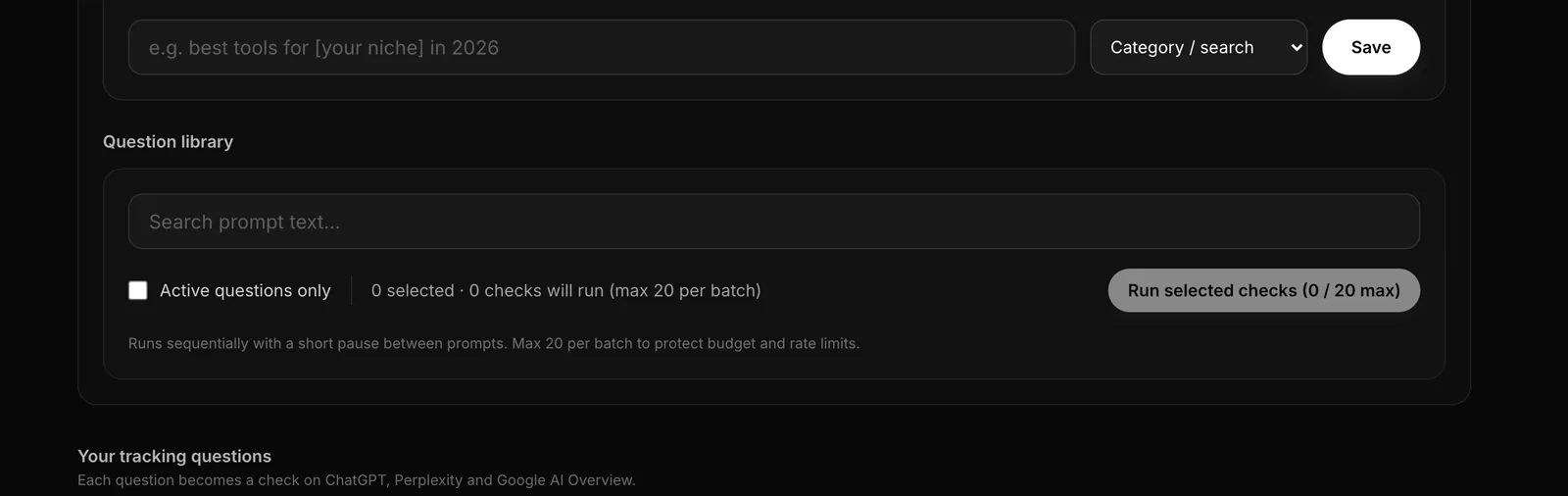
The tracked-prompts view — every buying question becomes a check across the engines, batched to protect the API budget.
The diagnosis before the first full run
The setup ends with a one-screen diagnosis: a site-health score and an AI-readiness score, plus the sentence that matters — for example, "ChatGPT doesn't mention you yet. Asked 'what are the best AI SEO tools?', it recommends instead: SEMrush, Ahrefs, Moz Pro, Yoast SEO, Screaming Frog SEO Spider." A healthy site with a real audience can still have no presence in the answer that decides the category. That is the gap in one panel:
Example diagnosis panel — a health score, an AI-readiness score, and the brands ChatGPT names for the category prompt.
The first batch of checks, honestly
After the first batch, the overview shows your AI Share of Voice, your citation rate (how often an AI answer linked to your site), and — crucially — a warning when the sample is too thin: "Early signal — based on only a handful of brand mentions across the completed checks. Run more prompts for a reliable score." A head-to-head against a discovered competitor shows who, if anyone, is being recommended yet. A "Mentioned" result that came from a prompt containing your own name is reported but kept out of the share of voice, so a comparison query can't inflate it. Take the small-sample warning seriously: a share of voice built on a dozen-odd answers is a direction, not a verdict.
What you do with it
Every "Absent" row carries a "Generate content" action, because the fix for an absent prompt is a page the engines can retrieve and cite for that question. The overview groups these as content opportunities — "for these prompts AI recommends your competitors but not you." Your next moves are exactly that list: a page that answers "best AI SEO tools" on its own terms, and pages for the use-case prompts you're missing. Being early is the advantage here; the classic suites ChatGPT named have had years to become the default answer, and the category question is still open.
What a good AI visibility checker gives you
Beyond a single score, the output that actually changes what you do next breaks into four parts — each of which you saw in the walkthrough above.
AI Share of Voice over time
The trend line, per engine, of how often you're named. It's the one number to watch, because it tells you whether your GEO work is compounding or stalling — something a one-off manual tally can never show you. The line starts wherever you are today; the point of publishing the pages the absent prompts call for is to watch it move on the next weekly scan, and to know which page moved it.
The competitors AI recommends instead of you
A ranked list of the brands the engines put forward in your place, by mention count. This is your real competitive set in generative search — and it's often not the same names you track on Google or the ones a keyword-overlap tool discovers, because the models synthesise a different mix of sources. For AI SEO tools that means SEMrush, Ahrefs, Moz Pro, Yoast and Screaming Frog, not the keyword-overlap set.
The prompts you're missing
Not a vanity metric: the specific buying questions where you don't appear. Each one is effectively a content brief — the page you haven't written yet, or the page that isn't earning the citation it should. "alternatives to Rankability for AI SEO software" and "best AI SEO tools for freelancers in Sicily" are exactly the kind of prompts that become pages on your list, and the tool links each absent prompt straight to a content generator so the brief doesn't sit in a spreadsheet.
The source pages the engines cite
The URLs the AI actually leaned on to build its answer, listed per check in the sources view. Knowing them tells you what format and depth the models trust for your category, so you can publish or improve to match rather than guess. When ChatGPT builds "best AI SEO tools" from a handful of comparison roundups, the page that earns you a citation looks like a comparison roundup — not a product page.
Free check first, then continuous tracking
The free check
Start with the free check — a one-off look at whether AI answers name you, no signup and no credits. It's the ten-minute manual method, done for you, in a single screen, and it answers the only question that matters on day one: are you in the answer or not?
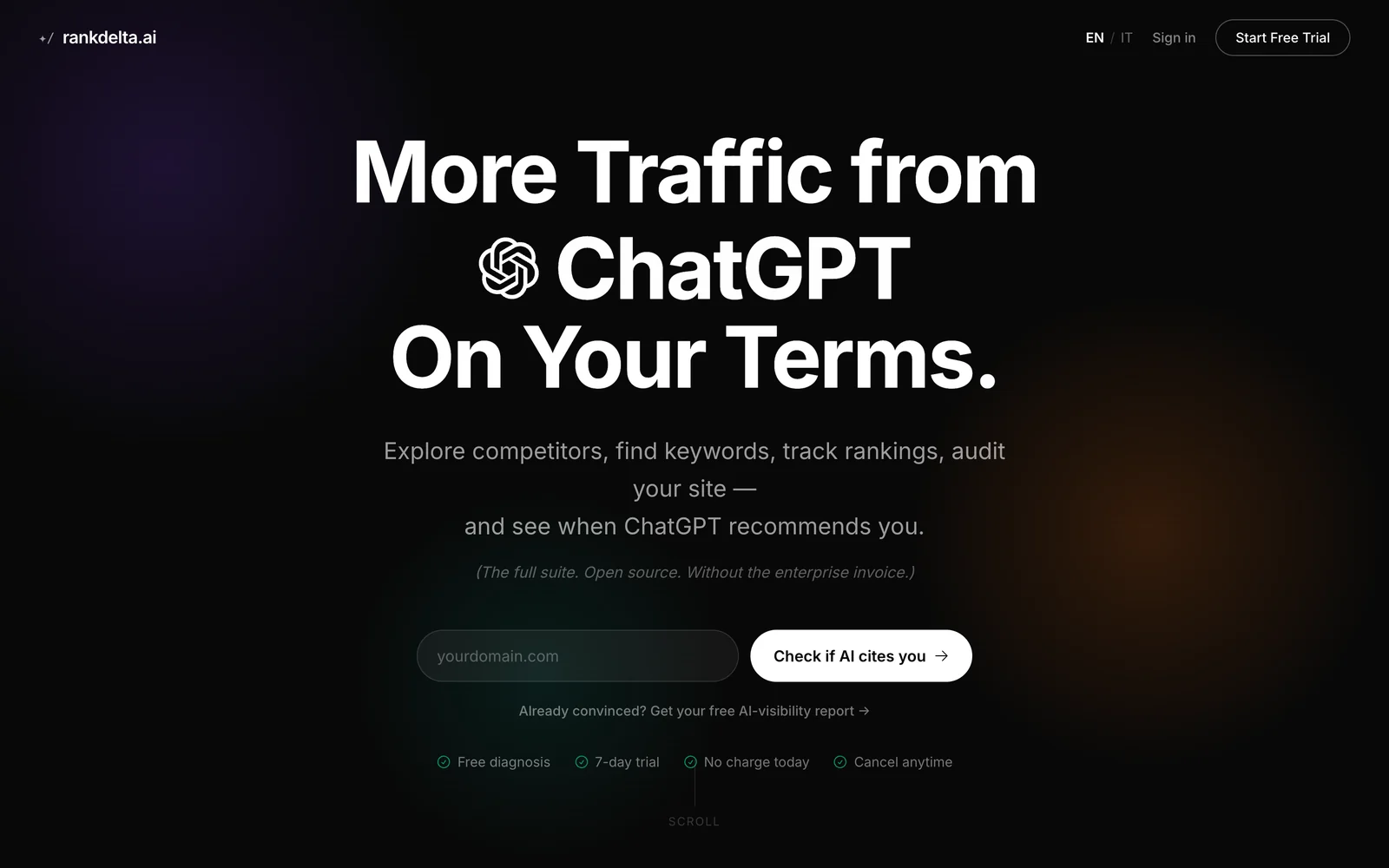
The free check on rankdelta.ai — no signup, one domain, one answer.
Continuous tracking, open-source or hosted
When you want it watched over time, RankDelta measures your AI Share of Voice across ChatGPT, Perplexity, Gemini and Google AI Overviews, ranks the competitors the engines recommend instead of you, and flags the prompts you're absent from. It's open-source and self-hostable, so client data can stay on your own infrastructure and you pay only for the data APIs you use, or hosted from $29/month with hard per-account spend caps — the same cap that keeps a scan to twenty checks per batch. For where it sits among the options, see AI visibility tools.
Agent-native over MCP
The tracker is also agent-native: connect it over MCP and Claude, ChatGPT or Cursor can pull your visibility directly — the share of voice, the recommended-competitor list, the absent prompts — without a dashboard in the loop, so an agent can run the check and draft the missing page in one session (see the best MCP server for SEO).
When a checker isn't what you need yet
Honest limits. If AI answers aren't part of how your buyers decide — a purely local business whose customers walk in, or a category no one researches through an assistant — a classic rank tracker is enough for now. A checker also only pays off if you'll act on it: knowing ChatGPT names a competitor helps only if you'll ship the page that earns the citation. And a one-off free check answers "where do I stand?" perfectly well; you don't need continuous tracking until the number is something you intend to move and defend. Finally, respect the sample size: a dozen-odd checks tell you whether you're absent, not by how much — the reliable score needs more prompts and more runs.
How this differs from rank tracking, in one line
A rank tracker tells you your position in Google's blue links. A checker tells you whether generative engines cite or recommend you in their answers — a separate surface with separate winners. You want both, and Google itself now surfaces AI Overviews above classic results for many queries and reports some generative impressions inside Search Console. Measuring only rankings leaves that surface dark — a strong site-health score can sit right next to a near-zero AI Share of Voice.
Pick your next step
Run the free check to see where you stand, read what AI visibility is for the concept, then compare approaches in AI visibility tools. When you're ready to track it, RankDelta does it open-source or hosted from $29/month — the same four steps you'd run by hand, on a schedule that never forgets.
Sources
- Ahrefs Keywords Explorer, Google US, 30 Aug 2026 —
ai visibility checkerKD 12, ~1.1K volume. - RankDelta AI-visibility checker — product walkthrough: profile inference, competitor discovery, prompt generation, and AI Share of Voice scoring across ChatGPT, Perplexity, Gemini and Google AI Overviews, September 2026.
- Google Search Central — documentation on Search features including AI Overviews and generative-AI reporting.