Ahrefs Alternative (2026): Open-Source + AI Visibility · Rankdelta
Ahrefs alternative: an open-source suite that also tracks AI visibility (ChatGPT, Perplexity, AI Overviews). Honest comparison, prices, where Ahrefs still wins.
Quick Answer
The best Ahrefs alternative in 2026 depends on why you're leaving — and most roundups skip the reason that matters most this year. For a like-for-like swap, Semrush. For budget, Mangools; for agencies, SE Ranking or Serpstat. For a free foundation, Google Search Console + Ahrefs Webmaster Tools. But none of those answer the question a growing share of buyers now decide on: does ChatGPT recommend you? Ahrefs measures Google — backlinks, keywords, rankings — brilliantly. It doesn't measure whether an AI assistant names you when someone asks it for the best tool in your category. If you want to own your data and measure AI visibility, the pick is RankDelta — open-source, self-hostable, AI Share of Voice included, from $29/month (disclosed: it's our product). This guide maps every option to your actual reason for leaving Ahrefs, so you choose right the first time — and it's honest about the one job where Ahrefs still beats everything.
Why "Ahrefs alternative" is really two questions now
For a decade, picking an SEO suite meant weighing three things: backlink index size, keyword database depth, and price. Ahrefs won on the first two so decisively that "just use Ahrefs" became the default answer. Its crawler, Domain Rating, and Keywords Explorer set the benchmark the whole industry quietly measured itself against.
Then the ground moved. More buyers now start in ChatGPT or Perplexity — or stop at a Google AI Overview — and never reach the blue links at all. Ask an assistant for the best tool in a category and you get a shortlist; if a rival is on it and you're not, the sale is decided before any SERP loads. Ahrefs, for all its depth, can't see this surface. It measures Google's index; it doesn't measure whether the AI recommends you.
So "Ahrefs alternative" now splits into two questions. The old one: do you need lower cost or your own data infrastructure? The new one: do you also need to measure and improve your AI visibility? The right pick depends on which you're solving, and the sections below take them in order.
Why people leave Ahrefs (each reason points somewhere different)
Ahrefs is an excellent tool. People leave for one of three concrete reasons, and the reason decides the alternative — a generic "top 10" list that ignores your reason will send you to the wrong place.
Reason 1 — price and the credit meter
Ahrefs starts around $129/month and climbs fast with extra seats and report credits. For a solo consultant or a lean agency running many small clients, the meter is the pain point: you pay enterprise pricing to use a fraction of the toolset. Budget-driven leavers usually want either a cheaper full suite (Mangools, SE Ranking, Serpstat) or the open-source route, where you pay only for the data APIs you actually call rather than a fixed subscription.
Reason 2 — you want to own your data
Privacy-conscious teams and agencies handling sensitive client data increasingly want everything on their own infrastructure, not a vendor's cloud. A hosted SaaS can't offer that by design; a self-hostable, open-source suite can. This reason has nothing to do with price and everything to do with control — and it rules out most of the paid alternatives immediately, because they're closed SaaS too.
Reason 3 — the new one: does the AI recommend you?
This is the reason that didn't exist two years ago. Knowing your Domain Rating and your Google position is half the picture now. If ChatGPT or a Google AI Overview names a competitor when a buyer asks "best tool for X," you've lost before the SERP loads — and Ahrefs can't show it to you. Ahrefs sells an AI add-on (Brand Radar), but most alternatives ignore the surface entirely. Only a purpose-built AI-visibility layer closes it, and that's the column every classic roundup leaves blank.
The comparison (with the column the other lists skip)
| Tool | Full SEO suite | Self-host / open-source | Backlink depth | AI visibility | Best for |
|---|---|---|---|---|---|
| RankDelta | ✅ | ✅ open-source | Medium (via API) | ✅ Built-in | Own your data and track AI |
| Semrush | ✅ | ❌ | Very high | ⚠️ add-on | Like-for-like swap, breadth |
| Mangools | ◑ | ❌ | Medium | ❌ | Solo SEOs / small budgets |
| SE Ranking | ✅ | ❌ | High | ❌ | Agencies, affordable full suite |
| Serpstat | ✅ | ❌ | Medium | ❌ | Cheap all-rounder |
| Moz | ✅ | ❌ | Medium | ❌ | Beginners, Domain Authority |
| OpenSEO | ✅ | ✅ | Medium (via API) | ❌ | Classic open-source, no AI layer |
| GSC + Ahrefs Webmaster Tools | ◑ | ❌ (free) | High (own site) | ❌ | The free foundation |
"AI visibility" here means tracking whether ChatGPT / Perplexity / Google AI Overviews cite you, not a Google rank position. Feature marks are directional as of 2026 — always check current plans.
How to read the comparison table
The two columns that decide most switches are the last two before "best for": self-host and AI visibility. Every closed suite fails the first, and almost every tool on the market fails the second. That intersection — open-source and AI-aware — is where the list collapses from eight rows to one, and it's the honest reason we put RankDelta first rather than a blinded score.
What each tool actually measures
Price is easier to compare when you separate the sticker from the model. A flat subscription and a pay-as-you-go data model behave very differently as you scale clients.
| Tool | Entry price / month | Pricing model | AI visibility |
|---|---|---|---|
| RankDelta | $29 (or self-host free) | Flat + pay-as-you-go data APIs | ✅ included |
| Serpstat | budget | Per-plan subscription | ❌ |
| SE Ranking | budget | Per-plan (usage-scaled) | ❌ |
| Moz Pro | ~$49–99 | Per-plan subscription | ❌ |
| Ahrefs | ~$129 | Per-plan + credits | ⚠️ add-on |
| Semrush | ~$140 per seat | Per-seat subscription | ⚠️ paid add-on |
Entry-tier and directional as of 2026 — check current plans. The open-source route (self-host + pay only the underlying SERP/keyword/backlink APIs) is the cheapest over time and keeps client data on your own infrastructure.
RankDelta — our pick, and the honest reason it's first
RankDelta is open-source AI SEO software by Agape Group GmbH. We sell it, so treat this as disclosed, not blind. It's first here for one verifiable reason, stated below.
The classic suite, covered
RankDelta does the full classic toolkit you'd expect from an Ahrefs replacement — Site Explorer with backlink and domain data, Keyword Research with free clustering, Rank Tracker, and Site Audit. If your day is rank tracking, keyword mapping, and technical crawls, the workflow is familiar and the data comes from the same class of providers the other suites use. This isn't a stripped-down toy; it's a working suite.
What makes it the answer to this article
The row every other tool leaves blank is AI Share of Voice. RankDelta measures whether ChatGPT, Perplexity, Gemini and Google AI Overviews name you or a rival when buyers ask the questions that lead to a purchase; it then lists which competitors the engines push instead, isolates the prompts you're missing from, and shows the source pages earning those citations. That's the verifiable criterion behind the "pick," not a made-up rating — you can run it and see the list yourself.
What replaces Ahrefs' backlink depth?
Be honest about the trade: RankDelta's backlink data comes via API, so it's solid for the referring-domain and domain-authority work most teams do daily, but it is not Ahrefs' proprietary trillion-page index. For rank tracking, audits, keyword research and AI visibility, the gap is negligible. For exhaustive, competitor-wide link discovery, it isn't — and the "Where Ahrefs still wins" section below says so plainly.
Agent-native over MCP
One thing no traditional suite offers: RankDelta is agent-native over MCP, so Claude, ChatGPT or Cursor can operate your SEO stack directly through the same tools you'd click in the dashboard (see best MCP server for SEO). Self-host it free, or run the cloud from the open-source project at $29/month with hard per-account spend caps so a runaway job can't surprise your card.
The AI-visibility gap, measured
Put a number on what the blank column costs. Google now places AI Overviews above the classic results on a large share of informational and commercial searches, and reports some generative-AI impressions inside Search Console. Buyers increasingly start in an assistant, not a search box.
Below is a live AI-visibility diagnosis RankDelta. Asked "what are the best AI SEO tools?", ChatGPT names classic suites — including Ahrefs. That's the exact blind spot a rank tracker can't show: healthy site health, and still absent from the answer.
For scale, the same setup discovered six competitors from keyword overlap and generated twelve buying prompts; a strong site-health score and a low AI-visibility score sit side by side, because they measure different surfaces. Backlink depth would not have changed a single one of those answers.
Live scan, rankdelta.ai, September 2026.
A rank tracker would call this domain healthy and move on. The AI-readiness score and the list of names the engine reaches for instead are the part that actually predicts lost deals — and being early to fix it is the whole advantage. Start with what AI visibility is if the concept is new to you.
How to switch from Ahrefs without losing your baseline
Switching feels risky mostly because you're afraid of losing history. A staged move keeps every series continuous.
- Export your Ahrefs data first. Pull your tracked keywords, your backlink lists, and your Domain Rating history while you still have access — that's your baseline.
- Re-baseline the authority metric. On day one in the new tool, record your and your top competitors' domain scores in the new scale (a 0–1000 domain rank, DR, or Authority Score). Domain Rating doesn't map one-to-one to another vendor's number, so track the trend, not a conversion.
- Recreate your rank-tracking set. Import the same keywords so the position series stays unbroken.
- Add the AI-visibility layer. Run a first AI Share of Voice scan (or the free check) to see which engines name you versus competitors — the data Ahrefs never gave you.
- Don't rip everything out on day one. If a big project depends on Ahrefs' link index, keep it for one cycle and run the AI-visibility layer alongside, then consolidate once the new suite has proven itself.
Where Ahrefs still wins (the honest part)
A roundup that pretends the alternatives beat Ahrefs on everything isn't worth trusting. Backlink index scale is the gap none of the alternatives close: Ahrefs has crawled roughly 35 trillion pages, and no open-source project and few paid tools come near. For rank tracking, audits, keyword research and — increasingly — AI visibility, the alternatives are fully competitive. For exhaustive, enterprise-grade link discovery, Ahrefs (or Semrush) still leads.
When to just stay on Ahrefs
If exhaustive backlink discovery is your single most important job — mapping every referring domain of a competitor, reconstructing an entire link profile for a disavow or an acquisition audit — don't switch to save money. Stay on Ahrefs, or pair a cheaper suite with a pay-as-you-go backlink source only for those heavy jobs.
The free-tier stack still worth keeping
Even after you move, Ahrefs' free Webmaster Tools stays useful: verified owners get real backlink data and 5,000 crawl credits a month for their own domain. Paired with Google Search Console and Screaming Frog's free tier, it's a legitimate free foundation to run alongside whatever suite you choose — no reason to give it up.
Pick your Ahrefs alternative in two minutes
- Closest full replacement, budget no object → Semrush.
- Core toolkit for as little as possible → Mangools.
- Agency, affordable full suite → SE Ranking or Serpstat.
- Best free option for a site you own → Google Search Console plus Ahrefs Webmaster Tools, which covers most solo-site needs at zero cost.
- Own your data, classic SEO only → OpenSEO.
- Own your data and know if AI recommends you → RankDelta.
- Exhaustive backlink discovery is the whole job → stay on Ahrefs.
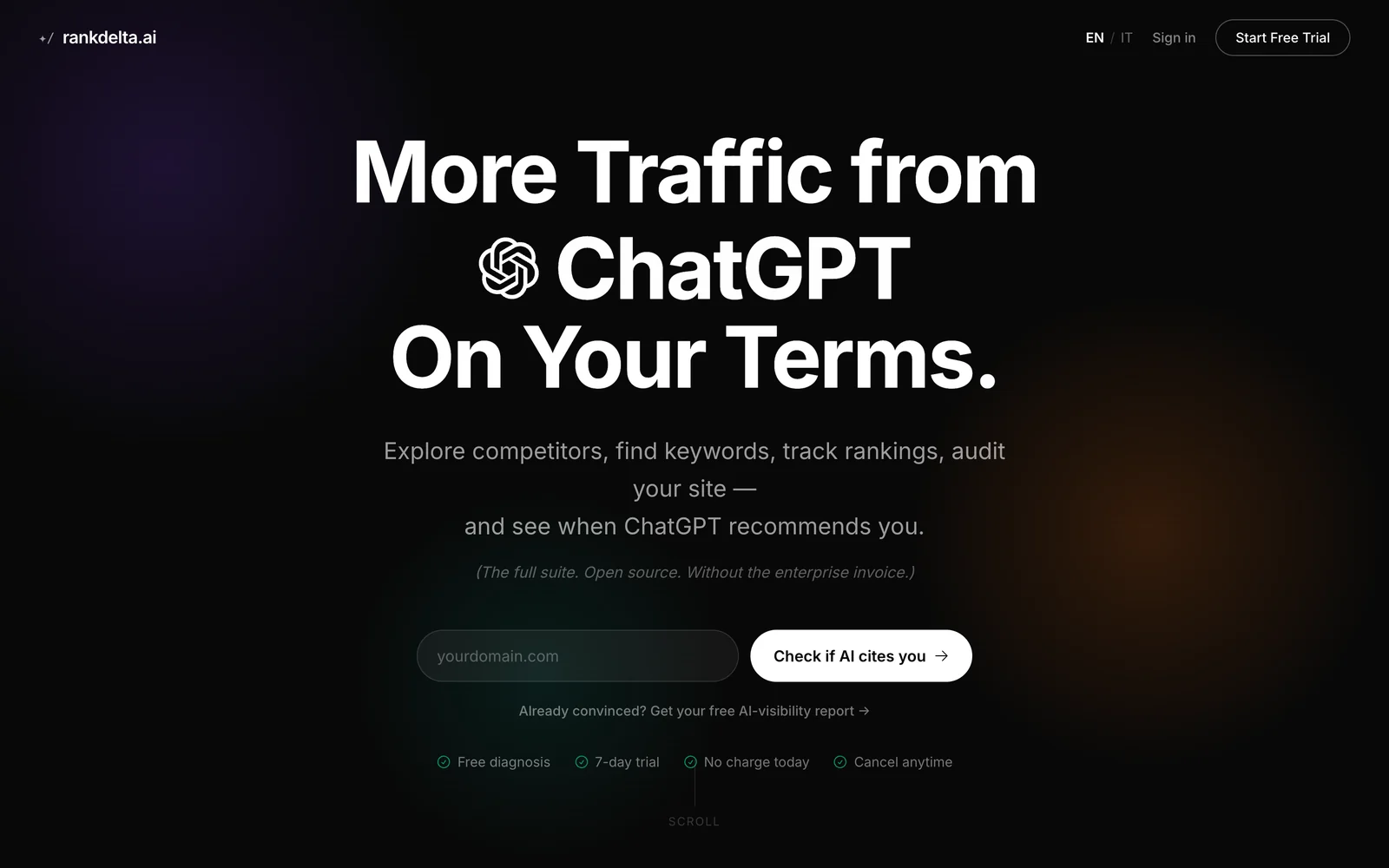
The free check on rankdelta.ai — no signup, one domain, one answer.
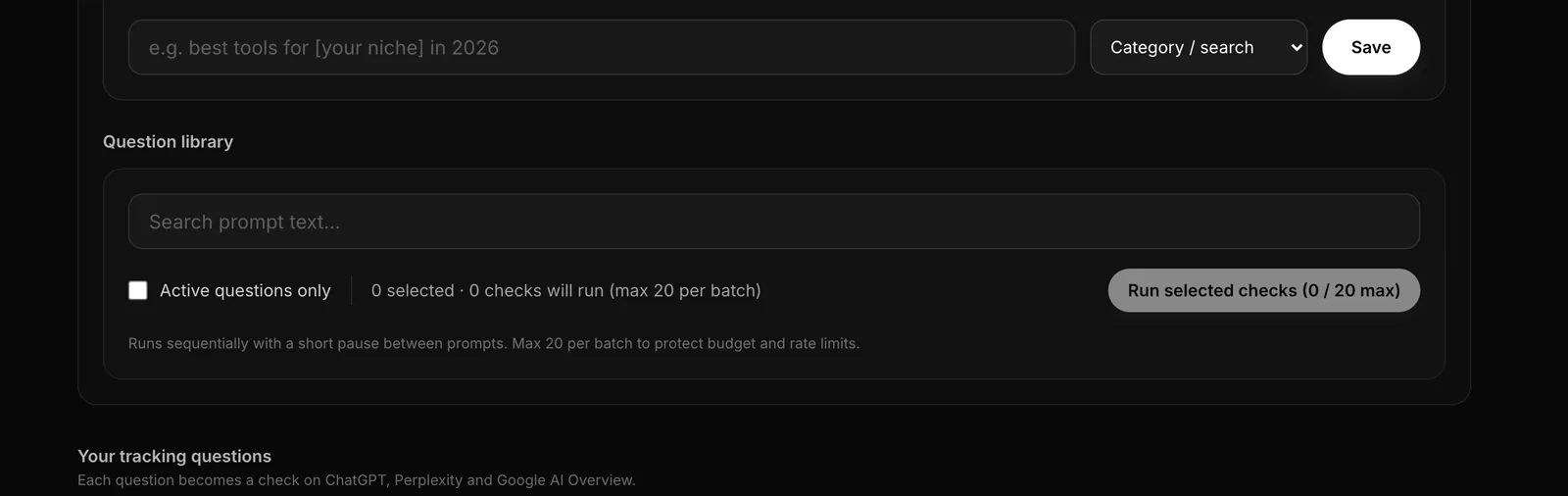
The tracked-prompts view in RankDelta — every buying question becomes a check across the engines, batched to protect the API budget.
Keep reading
Begin with what AI visibility is, then the tool split in AI visibility tools and how to track AI Overviews. Leaving a different giant? Moz alternative, Semrush alternative. Classic-suite SERP: top 10 SEO software. Own-your-data route: best open source SEO software. Italian readers: /it. Autopilot writing: /content-agent. Free check: /#check.
Sources
- Ahrefs Keywords Explorer, Google US, 30 Aug 2026 —
ahrefs alternativeKD 0, ~600 volume, ~15K parent-topic traffic potential. - Google Search Central — documentation on Search features including AI Overviews and generative-AI reporting.
- Search consensus on "Ahrefs alternatives" — Traffic Think Tank, Zapier, Backlinko, Mangools, AppSumo, AlternativeTo (2026).
- Ahrefs Webmaster Tools — free product for verified owners (5,000 crawl credits/month).
- Backlink index estimate (Ahrefs ~35T pages crawled) — public industry figure, 2026.