Semrush Alternative (2026): Cheaper + Open-Source + AI · Rankdelta
Semrush alternative for 2026: cheaper, open-source, AI visibility included instead of a paid add-on. Every option compared, plus where Semrush still wins.
Quick Answer
The best Semrush alternative in 2026 depends on why you're leaving — and most roundups skip the reason that matters most this year. For a like-for-like swap with a bigger backlink index, Ahrefs is the consensus pick. For budget, Moz Pro (~$49/mo vs Semrush's ~$140 entry) or Serpstat. For agencies, SE Ranking (affordable full suite, free data migration from Semrush). The free foundation is Google Search Console plus Ahrefs Webmaster Tools. But none of those answer the question that's new this year: does ChatGPT recommend you? Semrush measures your Google rank and sells AI-mention tracking as a paid add-on. If you're leaving to escape the price and you want AI visibility built in — not upsold — that's RankDelta: open-source, self-hostable, AI Share of Voice included, from $29/month (disclosed: it's our product). This guide maps every option to the specific reason you're leaving Semrush, is honest about where the giant still wins, and ends with a two-minute decision framework so you pick right the first time.
Why "Semrush alternative" is a different question in 2026
For a decade, choosing an all-in-one marketing suite meant weighing database size, toolset breadth, and price. Semrush won that race by being the broadest platform on the market — not just SEO, but paid search, social, content marketing, PR and competitive research in one login, on one of the largest keyword databases anywhere. That breadth is exactly why people both stay and leave: you pay for a marketing platform even when you only use the SEO corner of it.
But the ground moved this year. The buying journey increasingly begins in an AI answer rather than a search box: ChatGPT, Perplexity, a Google AI Overview. Those answers name a handful of tools. Miss the handful and you've lost the buyer before Semrush's rank report is even relevant. Classic suites, Semrush included, can't see this surface natively; Semrush bills AI mentions as a separate line item rather than answering whether the AI recommends you.
So "Semrush alternative" now splits into two questions. The old one: do you need the same breadth, a lower price, or better data ownership? The new one: do you also need to measure and improve your AI visibility? The right alternative depends on which you're solving.
Why people leave Semrush (each reason points somewhere different)
Semrush isn't a weak tool — it's the most complete one. People leave for one of four concrete reasons, and the reason decides the alternative.
Reason 1 — you use only a fraction of the platform
Semrush bundles PPC, social, content, and market research on top of SEO. If you only ever open the SEO tools, you're paying enterprise price for an all-in-one you half-use. That's the most common reason of all — and it points to a focused, cheaper SEO tool (Moz Pro, SE Ranking, Serpstat) that covers the part you actually touch.
Reason 2 — the price, per seat
Semrush's entry Pro plan starts around $140/month, per seat, before add-ons. Agencies juggling many clients and logins feel that fast. The budget suites cut the bill for the same core jobs — rank tracking, keyword research, audits — and the open-source route cuts it further by charging only for the data APIs you actually call.
Reason 3 — you want to own your data
Privacy-minded teams and agencies handling sensitive client data increasingly want everything on their own infrastructure, not a vendor's cloud. Semrush is a hosted platform by design: your projects, tracked keywords, client domains and competitor sets sit on its servers under its terms, and the per-seat model means the bill scales with the team rather than with the data you actually pull.
The open-source route inverts both. You self-host the suite (a Docker host plus a Supabase instance for the database and auth), bring your own API keys for SERP, keyword and backlink data, and pay those calls at cost — no seat count, no annual lock-in, and a database you can export or take with you. For agencies under client NDAs or data-residency requirements it's usually the deciding factor; for a solo consultant it's mostly a cost story. The honest limit is the same in every article of this series: Semrush's keyword database and backlink index are larger than anything you'll self-host, so the heaviest enterprise research still pairs best with a pay-as-you-go data source.
Reason 4 — the new one: AI visibility Semrush treats as an add-on
This is the reason that didn't exist two years ago. Knowing where you rank on Google is half the picture. If ChatGPT or a Google AI Overview names a competitor when a buyer asks "best tool for X," you've lost before the SERP loads — and Semrush only surfaces this if you pay for the AI-mentions add-on. Most alternatives can't see it at all; only a tool that includes AI visibility natively closes the gap without a second invoice.
The comparison (with the column Semrush roundups skip)
The seven contenders at a glance
| Tool | Full suite | Self-host / open-source | Backlink data | AI visibility | Entry price | Best for |
|---|---|---|---|---|---|---|
| RankDelta | ✅ | ✅ open-source | ✅ (via API) | ✅ Built-in | $29/mo (or self-host free) | Escaping price and getting AI visibility |
| Ahrefs | ✅ | ❌ | Very high (~35T pages) | ⚠️ add-on | ~$129/mo | Like-for-like swap, backlink depth |
| Moz Pro | ✅ | ❌ | Medium | ❌ | ~$49/mo | Budget, Domain Authority workflows |
| SE Ranking | ✅ | ❌ | High | ❌ | budget | Agencies (free Semrush migration) |
| Serpstat | ✅ | ❌ | Medium | ❌ | budget | Affordable all-rounder |
| SpyFu | ◑ (PPC/competitor) | ❌ | Medium | ❌ | budget | Competitor & PPC research |
| GSC + Ahrefs Webmaster Tools | ◑ | ❌ (free tools) | High (own site) | ❌ | Free | The free foundation |
Prices are entry-tier and directional as of 2026 — check current plans. "AI visibility" = tracking whether ChatGPT / Perplexity / Google AI Overviews cite you, not a rank position.
What each tool actually measures
Prices tell you the sticker; this table tells you the job — and shows why a cheaper tool can still be the right tool, and why the AI-visibility row is where the field thins out.
| Job to be done | Semrush | Budget suites (Moz / SE Ranking / Serpstat) | Free foundation (GSC + AWT) | RankDelta |
|---|---|---|---|---|
| Keyword research | ✅ huge database | ✅ solid | ◑ your own queries only | ✅ + free clustering |
| Rank tracking | ✅ | ✅ | ◑ (GSC positions) | ✅ |
| Backlink analysis | ✅ very high | ◑ medium–high | ◑ your own links | ✅ via API |
| Site audit | ✅ | ✅ | ❌ | ✅ |
| PPC / social / content | ✅ (the moat) | ❌ mostly | ❌ | ❌ SEO-focused |
| AI Share of Voice | ⚠️ paid add-on | ❌ | ❌ | ✅ included |
| Data ownership / self-host | ❌ | ❌ | ❌ | ✅ |
| Agent-native (MCP) | ❌ | ❌ | ❌ | ✅ |
Directional 2026 snapshot. The two bottom rows — AI Share of Voice included, and self-hostable/agent-native — are where the open-source route separates from every hosted suite.
RankDelta — our pick, and the verifiable reason it's first
RankDelta is open-source AI SEO software by Agape Group GmbH. We sell it, so treat this as disclosed, not blind. It's first here for one verifiable reason, stated below.
RankDelta does the classic Semrush-style suite you'd expect from a replacement — Site Explorer with backlink and domain data, Rank Tracker, Keyword Research with free clustering, and Site Audit. What makes it the answer to this article is the row Semrush bills as extra and most alternatives leave blank entirely: AI Share of Voice. It measures whether ChatGPT, Perplexity, Gemini and Google AI Overviews recommend you or someone else for your category's buying questions — then it orders the competitors the engines favour, surfaces the prompts where you don't appear, and traces the pages being cited.
Two more things matter for the reasons people leave Semrush. It's open-source and self-hostable, so client data can live on your own infrastructure and you pay only for the data APIs you use — no fixed per-seat invoice, and the managed cloud has hard per-account spend caps. And it's agent-native over MCP: Claude, ChatGPT, or Cursor can operate your SEO stack directly, which no traditional suite offers (see best MCP server for SEO). The distinction that matters most against Semrush: AI visibility is included, not an upsell — you don't buy the suite and then buy the answer to "does the AI recommend me?" separately.
When not to pick us
If you genuinely run PPC, social, and content campaigns inside Semrush, no SEO-focused alternative — us included — replaces that breadth. And if exhaustive enterprise backlink discovery is your single most important job, the largest indexes still lead on raw scale. Two more honest cases: if a client contract names Semrush's own metrics as the reporting KPI (an Authority Score target, a Semrush-defined keyword-difficulty threshold), switching means renegotiating the KPI, not just the tool — the numbers aren't interchangeable across suites. And if you lean on its market and traffic-analytics add-ons to size a competitor's whole business, that's a breadth job no SEO suite, open-source or not, is trying to do. We'd rather tell you that than watch you churn.
The alternatives, one by one
Budget suites: Moz, SE Ranking, Serpstat, SpyFu
Moz Pro is the gentlest and cheapest of the paid suites (~$49/mo), home of the Domain Authority metric many teams still report against. SE Ranking and Serpstat are affordable full suites with frequent index updates — SE Ranking even offers free data migration from Semrush, which removes most of the switching friction for agencies. SpyFu leans into competitor and PPC intelligence rather than being a full SEO suite, so it fits a narrow job well and a broad one poorly.
The open-source route
RankDelta and OpenSEO are the two self-hostable suites; add SerpBear for free rank tracking and Matomo for privacy-first analytics to complete a stack you fully own. The trade-off is real: you take on hosting and the pay-as-you-go data APIs yourself, in exchange for no subscription and full data ownership. For a fuller breakdown, see best open source SEO software.
What replaces Semrush's keyword database?
The single biggest hesitation in leaving Semrush is its keyword database — one of the largest in the industry, and the thing power users open first every morning. Your workflow is built on its volumes, difficulty scores, and related-keyword suggestions.
No alternative replicates Semrush's exact numbers, because every tool models volume and difficulty its own way — a Semrush difficulty of 40 does not map one-to-one onto anyone else's. But the underlying data most tools use (including RankDelta, via DataForSEO-class APIs) draws on the same clickstream and SERP sources, so the directional signal — which keywords are worth chasing, which cluster together — holds up well. Track the trend rather than chasing a conversion between scales that doesn't exist. RankDelta's free keyword clustering does part of the grouping work Semrush charges for, which softens the landing.
Where Semrush still wins (the honest part)
A roundup that pretends the alternatives beat Semrush on everything isn't worth trusting, so here's the real limit. Semrush's moat is breadth, and it's genuine: it's not just an SEO tool but a marketing platform — paid search, social, content, PR and market research in one login. If your team runs cross-channel campaigns and lives in that keyword database daily, switching to a pure SEO tool means stitching several products back together, and you'll likely spend more, not less, once you've re-bought the pieces.
So the honest rule: leave Semrush when you use a fraction of it — then a focused, cheaper, or open-source SEO tool wins — or when you specifically need AI visibility it treats as an add-on. Stay when its cross-channel breadth is genuinely part of how your team works. On rank tracking, audits, keyword research and AI visibility the alternatives are fully competitive; on the widest marketing toolkit, Semrush still leads.
How the AI-visibility gap actually costs you
Why does the add-on column matter? Google now surfaces AI Overviews above the classic results for a large share of informational and commercial queries, and reports some generative-AI impressions inside Search Console. Buyers, meanwhile, increasingly start in ChatGPT or Perplexity, not a search box.
So a common failure mode looks like this: you rank #2 on Google for "best [category] tool," every Semrush metric is green — and yet the AI Overview and ChatGPT both recommend a competitor, because they synthesised a different set of sources. You never see it in a rank tracker, because a position-two blue link is not a citation. AI visibility is a separate surface with separate winners — precisely the surface Semrush asks you to pay extra to glimpse.
This is what it looks like when you actually measure it. Below is a live AI-visibility diagnosis RankDelta. Asked "what are the best AI SEO tools?", ChatGPT lists SEMrush first — the exact blind spot a rank tracker can't show:
Worth noting which lists diverged: the six competitors the tool discovered from keyword overlap (Onelittleweb, Searchatlas, Athenahq, Zapier, Whatagraph, Rankability) were not the brands ChatGPT actually put in front of a buyer — the two sets barely touch. Semrush's breadth shows you the first list; only the AI layer shows you the second.
Live scan, rankdelta.ai, September 2026. The tool measures the surface a rank tracker can't — and being early to it is the advantage.
How to switch from Semrush (a low-risk path)
- Export your Semrush data first. Pull your tracked keywords, project audits, and backlink lists while you still have access — you'll want the baseline before the seat lapses. Moving to SE Ranking, its free migration does part of this for you.
- Re-baseline your metrics. On day one, record your and your competitors' domain scores, keyword difficulty and volumes in the new scale. They won't match Semrush one-to-one; the trend is what matters.
- Recreate your rank-tracking set. Import the same keywords so the time series stays continuous and you don't lose history at the switch.
- Add the AI-visibility layer. Run a first AI Share of Voice scan (or the free check) to see which engines name you versus competitors — the data Semrush charges an add-on for, and most alternatives never gave you at all.
- Don't rip everything out on day one. If your team genuinely uses Semrush's PPC or social modules, keep it for a cycle and run the SEO plus AI-visibility tool alongside, then consolidate once the new suite has proven itself.
Pick your Semrush alternative in two minutes
- Closest full replacement, budget's fine → Ahrefs.
- Only use the SEO part, want to pay less → Moz Pro or Serpstat.
- Agency wanting an affordable suite with easy migration → SE Ranking.
- Mainly competitor and PPC research → SpyFu.
- Best free option for your own site → GSC + Ahrefs Webmaster Tools.
- Own your data, classic SEO only → OpenSEO (self-host).
- Escape the price and know if AI recommends you → RankDelta.
- You genuinely use Semrush's cross-channel breadth → stay on Semrush.
The bottom line
There isn't one "Semrush alternative" — there's the right one for your reason to leave. Breadth you'll miss → stay. Budget → Moz, SE Ranking, or Serpstat. A like-for-like swap → Ahrefs. Data ownership → the open-source stack. And if the question that keeps you up isn't only "where do I rank on Google?" but "does the AI recommend me?", that's the gap Semrush bills as an add-on and the reason we built RankDelta open-source with AI Share of Voice included. The lowest-risk way to know where you stand is to run the free check — no signup — and if you need Semrush's full marketing breadth, we just told you to keep it.
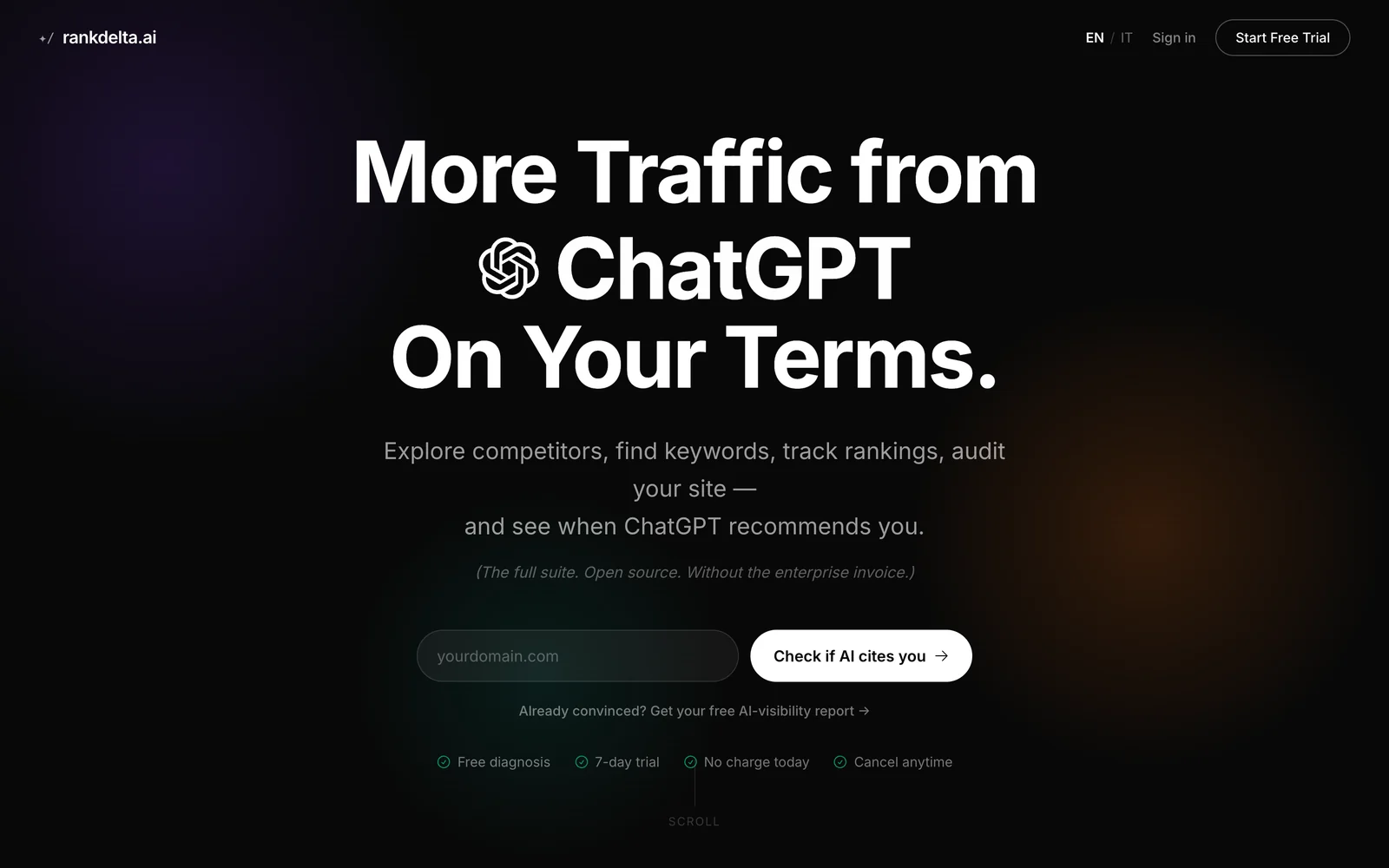
The free check on rankdelta.ai — no signup, one domain, one answer.
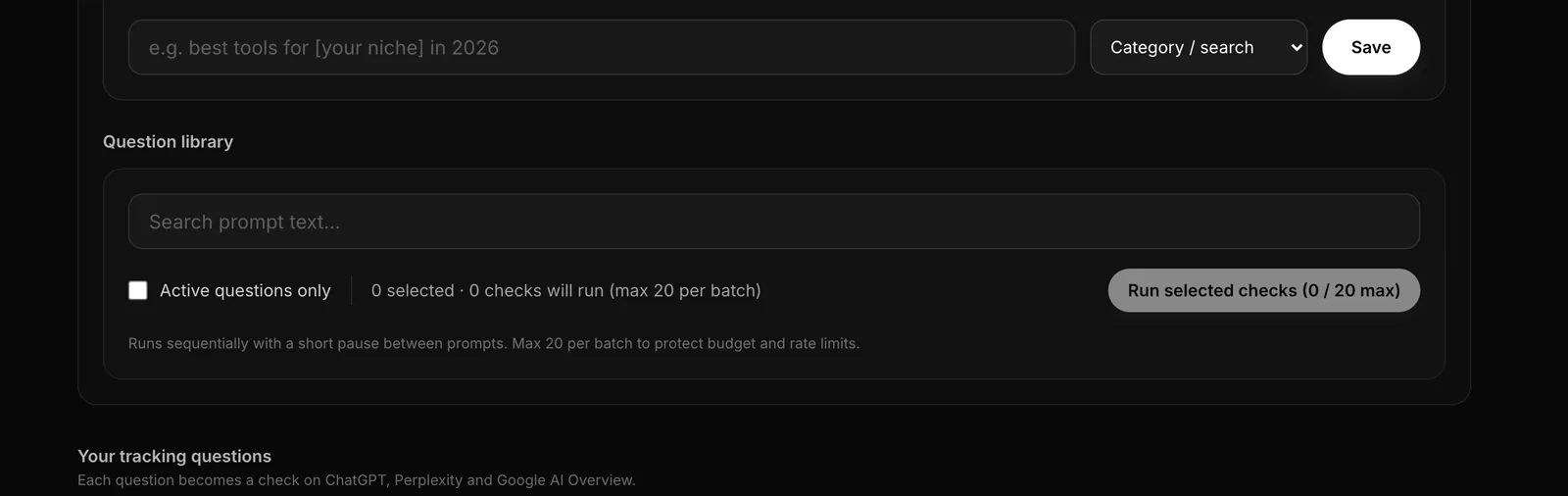
The tracked-prompts view in RankDelta — every buying question becomes a check across the engines, batched to protect the API budget.
Go deeper
Start from what AI visibility is, then the tool split in AI visibility tools and how to track AI Overviews. Leaving Ahrefs instead? Ahrefs alternative. Prefer the friendlier suite? Moz alternative. Own-your-data route: best open source SEO software. Classic-suite SERP: top 10 SEO software. Free check: /#check. Autopilot writing: /content-agent.
Sources
- Ahrefs Keywords Explorer, Google US, 30 Aug 2026 —
semrush alternativeKD 0, ~3.7K volume. - Google Search Central — documentation on Search features including AI Overviews and generative-AI reporting.
- Search consensus on "Semrush alternatives" — SpyFu, SEO.com, Traffic Think Tank, SE Ranking, SEOTesting, AlternativeTo (2026).
- Ahrefs Webmaster Tools — free product for verified owners.
- Backlink index estimates (Ahrefs ~35T pages, Semrush ~43T backlinks) — public industry figures, 2026.