SE Ranking vs Ahrefs vs Semrush (2026): Honest Comparison · Rankdelta
SE Ranking vs Ahrefs vs Semrush: price vs depth vs breadth, compared honestly — and the AI-visibility gap all three share, with the option that closes it.
Quick Answer
SE Ranking vs Ahrefs vs Semrush is really one trade-off: price versus depth. SE Ranking is the cheapest full suite and the value pick for most agencies — the same core jobs (rank tracking, keyword research, audits, competitor analysis) for less. Ahrefs leads on backlink index depth and a clean, focused SEO workflow. Semrush is the broadest of the three — SEO plus PPC, social and content, on the largest keyword database — and priced accordingly, per seat. Pick by which axis you weigh most: cost, link depth, or cross-channel breadth. But here's what every "SE Ranking vs Ahrefs vs Semrush" comparison skips in 2026: all three measure Google, not whether ChatGPT and Google AI Overviews recommend you. A growing share of buyers now ask an AI before they click a blue link, and none of the three includes that surface as standard — SE Ranking's coverage is limited, Ahrefs and Semrush sell it as an add-on. Disclosed: the option that closes that shared gap is our product, RankDelta (open-source, AI Share of Voice included, from $29/month).
The trade at the heart of it: price vs depth vs breadth
Line the three up and, on the classic SEO jobs, they look almost interchangeable. All three track rankings, research keywords, audit sites, analyse competitors, and estimate link authority with their own 0–100 (or 0–1000) score. That overlap is real, and it's why the choice feels harder than it should be — you're not comparing features that exist versus features that don't, you're comparing degree.
Why all three feel similar until you look closely
Each one will do the daily work of an SEO team competently. The differences only surface at the edges: how big the backlink index is when you chase every referring domain, how large the keyword database is when you go long-tail, how much lives outside SEO when your remit widens to paid and social, and — the decider for a lot of teams — what it costs to put the whole team on it.
So the honest way to choose is not "which is best" in the abstract. It's "which of these three axes matters most to my work," because each tool wins a different one and none wins all three.
The three axes that actually separate them
Price is SE Ranking's axis. It's the cheapest full suite of the three, with usage-scaled plans that flex with how much tracking you actually do — which is why cost-conscious agencies, juggling many clients on thin retainers, gravitate to it.
Depth is Ahrefs' axis. Its backlink index is one of the largest in the industry (public figures put it around 35 trillion pages), and Domain Rating is a metric a lot of the industry already trusts and reports in.
Breadth is Semrush's axis. Beyond SEO it reaches into PPC, social, content marketing and market research, on what's widely regarded as the largest keyword database of the three — a genuine command centre if you use all of it.
The three-way comparison at a glance
Here is the whole trade in one view. Read it by column if you already know your priority, or by the AI visibility row if you don't — because that row is identical for all three, and it's the one this guide exists to flag.
| SE Ranking | Ahrefs | Semrush | |
|---|---|---|---|
| Price (directional) | 💚 cheapest full suite | ~$129+/mo | ~$140+/mo per seat |
| Backlink index | High | 🥇 very high (~35T pages) | 🥇 very high (~43T backlinks) |
| Keyword database | Solid | Large | 🥇 largest |
| Breadth beyond SEO | Limited | SEO-focused | 🥇 PPC + social + content |
| Link-authority metric | Domain Trust | Domain Rating (DR) | Authority Score |
| AI visibility | ⚠️ limited | ⚠️ add-on | ⚠️ paid add-on |
| Best for | Agencies on a budget | Backlink depth, clean workflow | Cross-channel teams |
Prices are entry-tier and directional as of 2026 — always check current plans. SE Ranking is the cheapest full suite of the three; Ahrefs and Semrush sit higher, with Semrush priced per seat.
The honest read: SE Ranking wins on cost (and offers a free data migration from Semrush). Ahrefs wins on backlink depth. Semrush wins on breadth. Between the three, the decision is genuinely down to which of those three axes you weigh most — so the next three sections take each tool on its own strongest ground.
SE Ranking — the value pick
SE Ranking is the one most agencies land on when the budget has to stretch across a roster of clients, and that reputation is earned rather than a discount gimmick.
What SE Ranking is genuinely best at
Its core strength is coverage-per-dollar. You get rank tracking, keyword research, competitor analysis, a site audit and reporting in one place, with usage-scaled pricing that lets a small team track a lot of keywords without an enterprise invoice. For freelancers and agencies whose work is the everyday blocking-and-tackling of SEO — not exhaustive link forensics — it does the job the giants do at a fraction of the cost.
It also lowers the switching cost deliberately: SE Ranking offers a free data migration from Semrush, which is exactly why a cost-conscious team churning off an expensive seat lands here rather than starting from scratch.
Where SE Ranking hits its ceiling
The trade-off is at the edges. Its backlink index, while solid, isn't in the same league as Ahrefs' or Semrush's for the heaviest link-discovery work, and its reach outside classic SEO is limited compared with Semrush's cross-channel spread. If your work depends on finding every referring domain, or on running paid and social from the same console, you'll feel the ceiling. For most teams, though, that ceiling sits comfortably above what they actually use.
Ahrefs — the backlink and workflow pick
Ahrefs built its name on links, and that heritage still defines what it's best at. If you asked a room of SEOs which tool they trust for a backlink profile, a lot of hands go up for this one.
What Ahrefs is genuinely best at
Two things. First, backlink index scale — public industry figures put it around 35 trillion pages, which makes exhaustive link discovery and competitor link audits its home turf. Second, workflow. Ahrefs stays deliberately focused on SEO rather than sprawling across every marketing channel, and that focus shows in a clean, fast interface that gets you from question to answer without wading through modules you don't use. Domain Rating, its 0–100 link-authority score, is also a metric much of the industry already speaks and reports in.
Where Ahrefs asks you to pay up
Ahrefs sits above SE Ranking on price (directionally around $129/month and up), and it doesn't try to be a PPC or social platform — if you want that breadth, it isn't the tool. Its AI-visibility coverage exists only as an add-on rather than something baked into the core product. None of that is a flaw so much as a set of deliberate boundaries: it's a deep, focused SEO instrument, priced like one.
Semrush — the breadth pick
Semrush is the widest net of the three. Where the others are SEO tools, Semrush is closer to a whole digital-marketing platform that happens to have world-class SEO inside it.
What Semrush is genuinely best at
Reach. Beyond rank tracking and keyword research — on what's widely regarded as the largest keyword database of the three — it covers PPC research, social media, content marketing, PR and market analysis. For a team that genuinely runs multiple channels and wants one command centre, that consolidation is a real advantage: one login, one data model, one set of competitor dashboards spanning organic, paid and content at once.
Where Semrush's breadth becomes overhead
Breadth has a price, literally. Semrush is the most expensive of the three and charges per seat, so putting a whole team on it adds up fast. And breadth only pays off if you use it — a team that lives entirely in the SEO tools is buying an enterprise, cross-channel platform to use a slice of it. That's the classic Semrush mismatch: paying for a command centre and driving one dashboard. If that's you, SE Ranking (or an open-source suite) is the cheaper fit for the same day-to-day SEO work.
The gap all three share
Now the row that's identical across the whole table. SE Ranking, Ahrefs and Semrush are all, at their core, tools for measuring Google — where you rank on blue links, how strong your backlink profile is, what a keyword is worth. That was the entire game for fifteen years. It isn't the whole game anymore.
Why AI visibility is a separate surface
A growing slice of buyers get their shortlist from ChatGPT, Perplexity or a Google AI Overview and never scroll the classic results. If the assistant names two of these three suites and skips yours, the comparison was settled before anyone opened a SERP. This is a distinct surface with its own winners: you can rank #2 on Google, have a healthy authority score, and still be completely absent from the AI answer, because the model retrieved and synthesised a different set of sources. Google itself now surfaces AI Overviews above the classic results for a large share of queries, so this isn't a fringe channel — it's the top of the page.
How each of the three treats it today
Look back at the AI-visibility row: SE Ranking's coverage is limited, Ahrefs offers it as an add-on, and Semrush sells it as a paid add-on. None of the three treats it as core. So a rank tracker — however good — structurally can't tell you whether the AI recommends you, because a position-two blue link is not the same thing as a citation in an AI answer. The only way to manage that surface is to measure it directly.
Measure it and the gap is plain. Below is a live AI-visibility diagnosis from RankDelta. Asked "what are the best AI SEO tools?", ChatGPT names classic suites — including SEMrush and Ahrefs: the exact blind spot a rank tracker can't show.
The pattern is the same on every engine — Perplexity and ChatGPT alike: a strong site-health score can sit next to a near-absent AI answer. Whichever of the three suites you pick, that number stays invisible to it.
Live scan, rankdelta.ai, September 2026.
The option that closes it (disclosed)
RankDelta is open-source AI SEO software by Agape Group GmbH. We sell it. We're naming it because it's the answer to the gap above, not because it out-scores the three on their own turf.
What RankDelta adds that the three don't
RankDelta does the classic suite you'd expect — Site Explorer with backlink and domain data, Rank Tracker, Keyword Research with free clustering, and Site Audit. The difference is the row all three giants leave to an add-on or skip: AI Share of Voice is included by default. It measures whether ChatGPT, Perplexity, Gemini and Google AI Overviews cite you or one of these three for your buying prompts; it ranks who the engines recommend instead, flags the prompts you're absent from, and points at the pages winning the citations.
Two more things follow from how it's built. It's open-source and self-hostable, so client data can live on your own infrastructure and you pay only for the data APIs you use — no fixed per-seat invoice, which is a real answer to Semrush's per-seat maths. And it's agent-native over MCP: Claude, ChatGPT or Cursor can operate the SEO stack directly, which no traditional suite offers (see best MCP server for SEO).
When not to pick RankDelta
It isn't the pick if exhaustive enterprise backlink discovery is your single most important job — Ahrefs and Semrush lead on raw index scale and we won't pretend otherwise. Nor is it the fit if you need Semrush's full cross-channel breadth across PPC, social and content in one console. RankDelta's job is the AI-visibility layer the three don't include, plus a competent classic suite around it — not to out-index the giants on their own turf.
Pricing side by side
Cost is the axis people underestimate, so here it is on its own — directional entry-tier pricing, not a quote.
| Tool | Entry price / month | Pricing model | AI visibility |
|---|---|---|---|
| RankDelta | $29 (or self-host free) | Flat + pay-as-you-go data APIs | ✅ included |
| SE Ranking | 💚 cheapest full suite | Per-plan (usage-scaled) | ⚠️ limited |
| Ahrefs | ~$129 | Per-plan subscription | ⚠️ add-on |
| Semrush | ~$140 per seat | Per-seat subscription | ⚠️ paid add-on |
Entry-tier and directional as of 2026 — always check current plans. The open-source route (self-host + pay only the underlying SERP/keyword/backlink APIs) is the cheapest over time and keeps client data on your own infrastructure.
The pattern is clear: SE Ranking is the cheapest of the three named suites, Semrush the most expensive because it charges per seat, and Ahrefs sits in between. RankDelta undercuts all three on the base subscription and folds in the AI layer the others charge extra for — but re-read the "when not to pick" note above before you treat price as the whole story.
Pick in two minutes
- Cheapest full suite, agency value → SE Ranking.
- Backlink depth, clean SEO workflow → Ahrefs.
- Cross-channel breadth (PPC / social / content) → Semrush.
- Own your data / cheaper than all three → an open-source suite.
- Measure whether AI recommends you, included → RankDelta.
- Keep your current suite, add AI visibility alongside → run a dedicated tracker next to it (start with the free check).
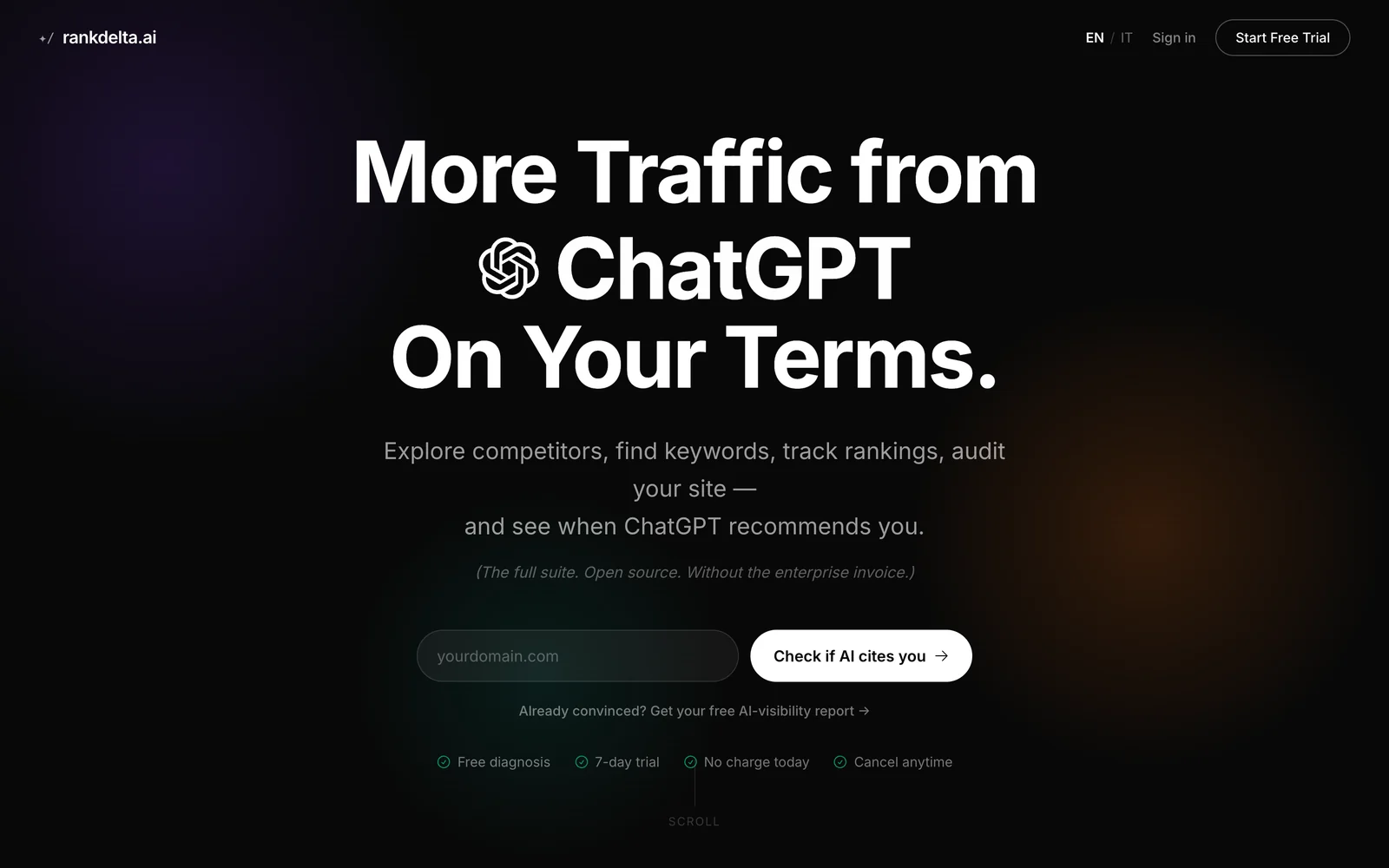
The free check on rankdelta.ai — no signup, one domain, one answer.
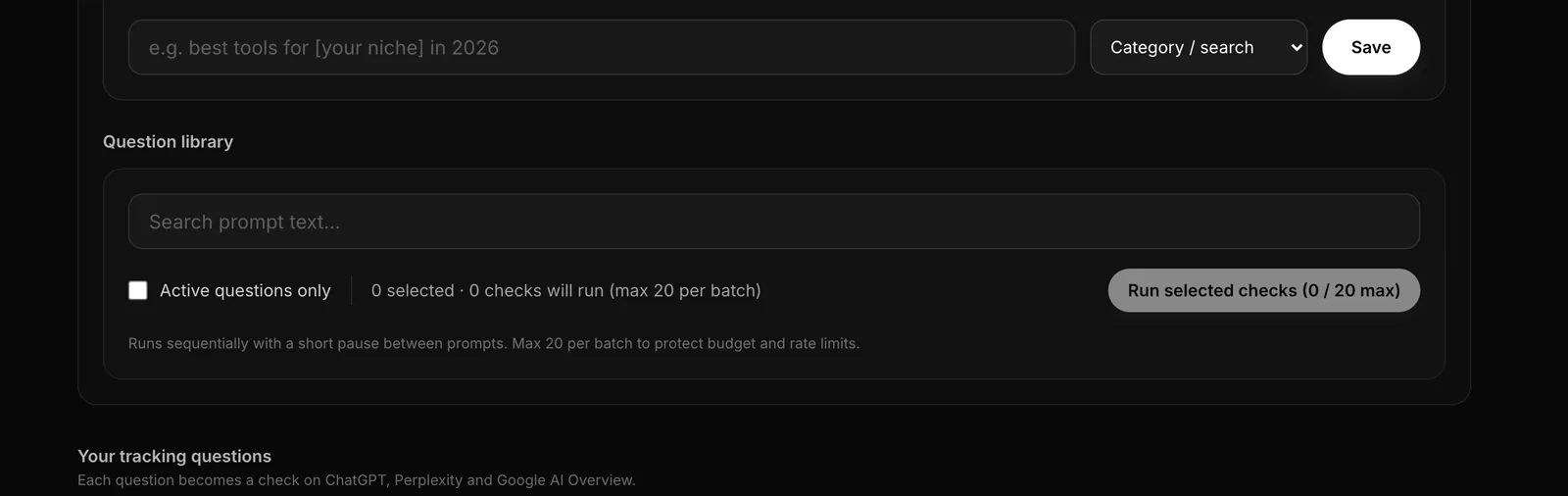
The tracked-prompts view in RankDelta — every buying question becomes a check across the engines, batched to protect the API budget.
Next reads
First, what AI visibility is, then AI visibility tools and how to track AI Overviews. Deciding on one giant? Ahrefs alternative, Semrush alternative, Moz alternative. Own-your-data route: best open source SEO software. Free check: /#check. Autopilot writing: /content-agent.
Sources
- Ahrefs Keywords Explorer, Google US, 30 Aug 2026 —
seranking vs ahrefsKD 3, ~350 volume;seranking vs semrushKD 2, ~300 volume. - Search consensus on SE Ranking / Ahrefs / Semrush comparisons (2026).
- Backlink index estimates (Ahrefs ~35T pages, Semrush ~43T backlinks) — public industry figures, 2026.