Moz Alternative (2026): Open-Source Pick + AI Visibility · Rankdelta
The best Moz alternative depends on why you're leaving: depth, price, or the question Moz ignores — does ChatGPT recommend you? Compared honestly.
Quick Answer
The best Moz alternative in 2026 depends on why you're switching. For a bigger backlink index and deeper data, Ahrefs or Semrush (higher price). For a cheaper full suite, SE Ranking or Serpstat. For a free foundation, Google Search Console + Ahrefs Webmaster Tools. But none of those answer the question that's new this year and that a growing share of buyers now decide on: does ChatGPT recommend you? Moz measures your Google rank and its own Domain Authority score — not whether AI assistants cite you. If you want to own your data and measure AI visibility, the pick is RankDelta — open-source, self-hostable, AI Share of Voice included, from $29/month (disclosed: it's our product). This guide maps every option to the specific reason you're leaving Moz, so you pick right the first time — and it's honest about where Moz and the giants still win.
Why "Moz alternative" is a different question in 2026
For fifteen years, choosing an SEO suite meant weighing backlink index size, keyword database depth, and price. Moz built a loyal base by being the friendly, approachable option in that race — Domain Authority became industry shorthand, and Link Explorer and its rank tracker cover the basics cleanly.
But the ground moved. A rising share of buyers now open ChatGPT, Perplexity, or read a Google AI Overview before they ever click a blue link. When someone asks an assistant "best tool for X," the model names a shortlist — and if a competitor is on it and you aren't, the deal is lost before the SERP even loads. Classic SEO tools, Moz included, can't see this surface. They measure Google rankings; they don't measure whether the AI recommends you.
So "Moz alternative" now splits into two questions, not one. First, the old question: do you need more depth, a lower price, or better data ownership than Moz gives you? Second, the new one: do you also need to measure and improve your AI visibility? The right alternative depends on which of those you're solving — and the sections below take them in order.
Why people leave Moz (each reason points somewhere different)
Moz isn't a weak tool — people leave for one of three concrete reasons, and the reason decides the alternative.
Reason 1 — you need more depth than Moz offers
Moz's backlink index and keyword database are smaller than the biggest players'. If your work depends on exhaustive link discovery — finding every referring domain, auditing a competitor's entire profile — you'll feel the ceiling. That points to Ahrefs or Semrush, whose indexes are an order of magnitude larger, at a correspondingly higher price.
Reason 2 — you want a lower price or a cheaper full suite
Moz Pro runs roughly $49–$99+ per month depending on tier. Agencies juggling many clients feel that fast, especially when they use a fraction of the toolset. SE Ranking and Serpstat cover the same core jobs — rank tracking, keyword research, audits — for less. The open-source route cuts it further: pay only for the data APIs you actually call.
| Tool | Entry price / month | Pricing model | AI visibility |
|---|---|---|---|
| RankDelta | $29 (or self-host free) | Flat + pay-as-you-go data APIs | ✅ included |
| Moz Pro | ~$49 | Per-plan subscription | ❌ |
| Serpstat | ~$50 | Per-plan subscription | ❌ |
| SE Ranking | ~$52 | Per-plan (usage-scaled) | ❌ |
| Ahrefs | ~$129 | Per-plan subscription | ⚠️ add-on |
| Semrush | ~$140 per seat | Per-seat subscription | ⚠️ paid add-on |
Entry-tier and directional as of 2026 — always check current plans. The open-source route (self-host + pay only the underlying SERP/keyword/backlink APIs) is the cheapest over time and keeps client data on your own infrastructure.
Reason 3 — you want to own your data
Privacy-minded teams and agencies handling sensitive client data increasingly want everything on their own infrastructure, not a vendor's cloud. Moz, like every hosted suite, keeps your tracked keywords, client domains and competitor sets on its servers under its terms — fine for most, a problem if a client contract or a data-residency policy says otherwise.
Owning the data means something concrete in practice: you run the software yourself (a Docker host plus a Supabase instance for the database and auth), you bring your own API keys for SERP, keyword and backlink data, and the underlying calls are billed at cost instead of bundled into a per-seat subscription. Client data never leaves machines you control, you can audit the code that touches it, and you can leave without an export — the database is yours. The trade you're making is index scale: no self-hosted suite matches the biggest proprietary backlink indexes, so the heaviest link-discovery jobs still pair best with a pay-as-you-go source.
Reason 4 — the new one: you need to measure AI visibility
This is the reason that didn't exist two years ago. Knowing your Domain Authority and your Google position is half the picture. If ChatGPT or a Google AI Overview names a competitor when a buyer asks "best tool for X," you've lost before the SERP loads — and Moz can't see it. Neither can most of the alternatives. Only a purpose-built AI-visibility tool closes it.
The comparison (with the column the other lists leave blank)
| Tool | Full suite | Self-host / open-source | Backlink depth | AI visibility | Entry price | Best for |
|---|---|---|---|---|---|---|
| RankDelta | ✅ | ✅ open-source | Medium (via API) | ✅ Built-in | $29/mo (or self-host free) | Owning your data and measuring AI |
| Ahrefs | ✅ | ❌ | Very high (~35T pages) | ⚠️ add-on | ~$129/mo | Depth, like-for-like upgrade |
| Semrush | ✅ | ❌ | Very high (~43T backlinks) | ⚠️ paid add-on | ~$140/mo | Breadth (PPC/social/content) |
| SE Ranking | ✅ | ❌ | High | ❌ | budget | Agencies wanting a cheap full suite |
| Serpstat | ✅ | ❌ | Medium | ❌ | budget | Cheap all-rounder |
| GSC + Ahrefs Webmaster Tools | ◑ | ❌ (free tools) | High (your site) | ❌ | Free | The free foundation |
Prices are entry-tier and directional as of 2026 — check current plans. "AI visibility" here means tracking whether ChatGPT / Perplexity / Google AI Overviews cite you, not a Google rank position.
RankDelta — our pick, and the honest reason it's first
RankDelta is open-source AI SEO software by Agape Group GmbH. We sell it, so treat this as disclosed, not blind. It's first here for one verifiable reason, stated below.
The classic suite you'd expect
RankDelta does the classic suite you'd expect from a Moz replacement — Site Explorer with backlink and domain data, Rank Tracker, Keyword Research with free clustering, and Site Audit. The baseline is already there.
The row the others leave blank: AI Share of Voice
What makes it the answer to this article, rather than one more entry in a listicle, is the row every other tool leaves blank: AI Share of Voice. It measures whether ChatGPT, Perplexity, Gemini and Google AI Overviews cite you or a competitor for the buying prompts in your category, ranks the competitors the engines recommend instead of you, flags the exact prompts where you're absent, and points to the source pages winning those citations.
Open-source, self-hostable and agent-native
Two more things matter for the reasons people leave Moz. It's open-source and self-hostable, so client data can live on your own infrastructure and you pay only for the data APIs you use — no fixed per-seat invoice. And it's agent-native over MCP: Claude, ChatGPT, or Cursor can operate your SEO stack directly, which no traditional suite offers (see best MCP server for SEO).
When not to pick us
If you only need classic SEO with zero AI layer, or if exhaustive enterprise backlink discovery is your single most important job, Ahrefs and Semrush still lead on raw index scale. We'd rather tell you that than watch you churn.
What actually replaces Domain Authority?
The single biggest hesitation in leaving Moz is Domain Authority (DA) — Moz's proprietary 0–100 predictive score. A lot of briefs, pitches and client reports are written in DA, so people worry that switching means losing a number their whole workflow speaks.
Here's the honest picture: nothing is identical, because DA is Moz's own model. But every serious tool has an equivalent link-authority estimate. Ahrefs has Domain Rating (DR), Semrush has Authority Score, and DataForSEO-based tools — RankDelta included — expose a 0–1000 domain rank. They're built on similar signals (referring domains, link quality) but on different scales, so they are directional, not interchangeable: a DA of 45 does not map to a DR of 45. The practical move when you switch is to re-baseline once — record your and your competitors' scores in the new metric on day one — and then track the trend, which is what actually matters, rather than chasing a one-to-one conversion that doesn't exist.
How the AI-visibility gap actually costs you
It's worth being concrete about why the blank column matters. Google itself now surfaces AI Overviews above the classic results for a large share of informational and commercial queries, and reports some generative-AI impressions inside Search Console. Meanwhile buyers increasingly start in ChatGPT or Perplexity, not a search box.
So a real, common failure mode looks like this: you rank #2 on Google for "best [category] tool," your Domain Authority is healthy, every Moz metric is green — and yet the AI Overview and ChatGPT both recommend a competitor, because they retrieved and synthesised a different set of sources. You never see it in a rank tracker, because a position-two blue link is not the same thing as a citation. AI visibility is a separate surface with separate winners, and the only way to manage it is to measure it.
Here's what that looks like measured. Below is a live AI-visibility diagnosis RankDelta. Asked "what are the best AI SEO tools?", ChatGPT names classic suites (including Moz Pro) — the exact blind spot a rank tracker can't show:
What that panel measures: a high site-health score — the kind a Domain-Authority-minded team would celebrate — sitting next to a much lower AI-readiness score. Healthy by every Moz-era metric, and still invisible where the buyer now asks.
Live scan, rankdelta.ai, September 2026. The tool measures the surface a rank tracker can't — and being early is the advantage.
How to actually switch (a low-risk path)
- Export your Moz data first. Pull your tracked keywords, your DA history, and your backlink lists while you still have access — you'll want the baseline.
- Re-baseline the authority metric. On day one in the new tool, record your and your top competitors' domain scores in the new scale (DR, Authority Score, or 0–1000 rank). Trend from there.
- Recreate your rank-tracking set. Import the same keywords so the series is continuous.
- Add the AI-visibility layer. Run a first AI Share of Voice scan (or the free check) to see which engines name you versus competitors — this is the data Moz never gave you.
- Don't rip everything out on day one. If your team lives in DA, you can even keep Moz for a cycle and run AI-visibility tracking alongside, then consolidate once the new suite has proven itself.
Where Moz (and the giants) still win
A roundup that pretends the alternatives beat Moz on everything isn't worth trusting, so here are two honest points.
Domain Authority as a shared language
Because so many people and briefs speak in DA, keeping Moz around can be worth it purely for continuity if your reporting is built on that number.
Backlink index scale
Ahrefs (35 trillion pages) and Semrush (43 trillion backlinks) outclass any open-source alternative for exhaustive link discovery. For rank tracking, audits, keyword research and — critically — AI visibility, the alternatives are fully competitive; for the very heaviest link work, pair your suite with a pay-as-you-go data source.
Pick your Moz alternative in two minutes
- Depth and index size, budget's fine → Ahrefs or Semrush.
- Cheaper full suite for an agency → SE Ranking or Serpstat.
- Best free for your own site → GSC + Ahrefs Webmaster Tools.
- You live by Domain Authority specifically → keep Moz.
- Own your data, classic SEO only → an open-source classic suite.
- Own your data and know if AI recommends you → RankDelta.
Conclusion
There isn't one "Moz alternative" — there's the right one for your reason to leave. Depth points to Ahrefs or Semrush; budget to SE Ranking or Serpstat; a free floor to GSC plus Ahrefs Webmaster Tools; data ownership to the open-source route. And if the question that actually keeps you up isn't only "where do I rank on Google?" but "does the AI recommend me?", that's the gap Moz doesn't measure and the reason we built RankDelta open-source with AI Share of Voice included. The lowest-risk way to find out where you stand is to run the free check — no signup — and if you need Moz's Domain Authority continuity, we just told you it's fine to keep it.
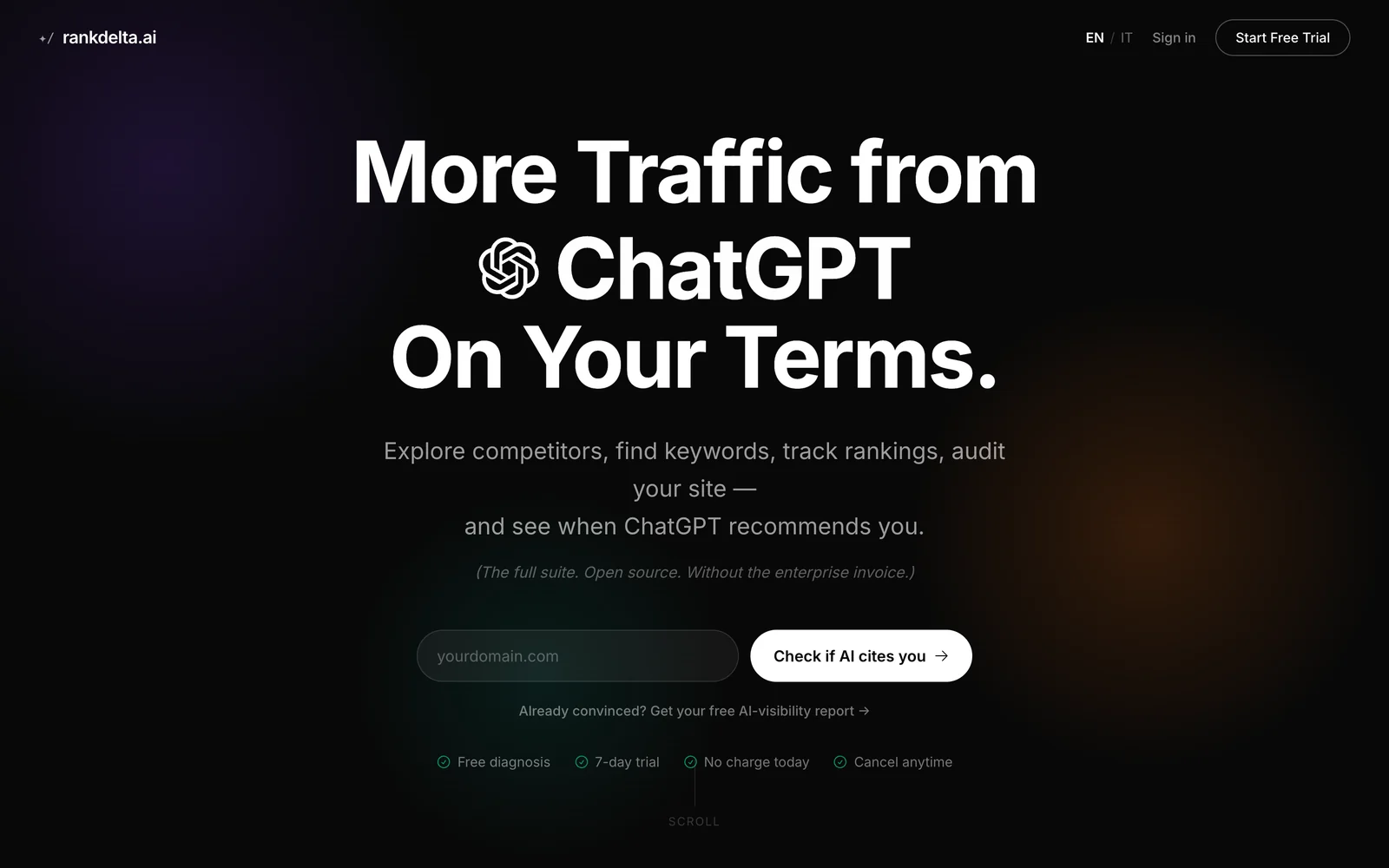
The free check on rankdelta.ai — no signup, one domain, one answer.
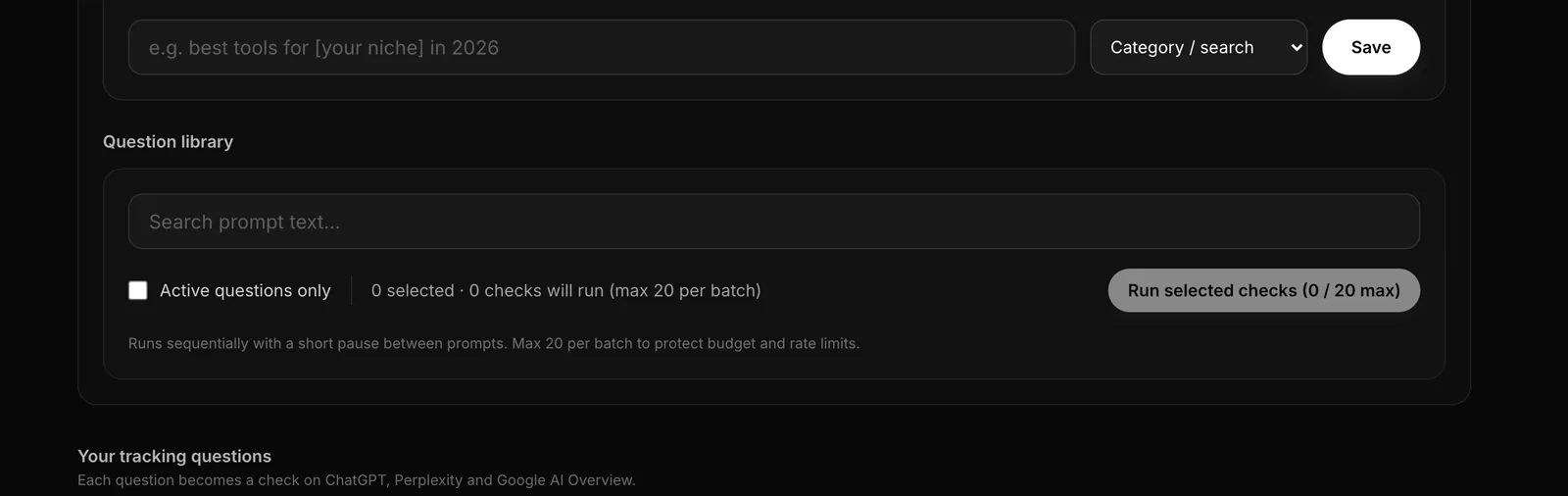
The tracked-prompts view in RankDelta — every buying question becomes a check across the engines, batched to protect the API budget.
Pair this with measurement
Start with what AI visibility is, then the tool split in AI visibility tools and how to track AI Overviews. Leaving a different giant? Ahrefs alternative, Semrush alternative. Own-your-data route: best open source SEO software. Classic-suite SERP: top 10 SEO software. Free check: /#check. Autopilot writing: /content-agent.
Sources
- Ahrefs Keywords Explorer, Google US, 30 Aug 2026 —
moz alternativeKD 0, ~2.2K volume. - Google Search Central — documentation on Search features including AI Overviews and generative-AI reporting.
- Search consensus on "Moz alternatives" — Ahrefs, Semrush, SE Ranking, Serpstat, AlternativeTo roundups (2026).
- Backlink index estimates (Ahrefs ~35T pages, Semrush ~43T backlinks) — public industry figures, 2026.