Ubersuggest Alternative (2026): The Step-Up Options · Rankdelta
Outgrown Ubersuggest? Compare the step-up options — Ahrefs, Semrush, SE Ranking, Serpstat — and the open-source pick that adds AI visibility: RankDelta.
Quick Answer
The best Ubersuggest alternative in 2026 depends on why you've outgrown it. Ubersuggest is the cheap, friendly beginner suite — a low price and a well-known lifetime deal — and people leave for one of four reasons. For deeper, more accurate data, Ahrefs or Semrush (the step up, at a higher price). For a cheaper serious suite at scale, SE Ranking or Serpstat. For the free floor, Google Search Console + Ahrefs Webmaster Tools. To own your data, the open-source route. But none of the usual names answer the question Ubersuggest ignores entirely this year: does ChatGPT recommend you? If you want to move up and measure that, it's RankDelta — open-source, self-hostable, AI Share of Voice included, from $29/month (disclosed: it's our product). This guide maps every option to the exact reason you're leaving, so you pick right the first time — and it's honest about where Ubersuggest still wins.
Why "Ubersuggest alternative" is really two questions now
Ubersuggest earned its base by being cheap and approachable. A low monthly price, a genuinely appealing lifetime deal, a clean interface, and enough keyword, audit and backlink data to get a beginner moving. For a first site, that combination is hard to argue with — and for a lot of people it's still the right tool.
But "which tool replaces Ubersuggest?" quietly became two questions, not one. The first is the old one: do you need more depth, fewer limits, or better data ownership than Ubersuggest gives you? The second is new this year: do you also need to measure whether AI assistants recommend you? More first-time buyers now ask ChatGPT or Perplexity, or read a Google AI Overview, before they ever type a query.
The reason you're leaving decides the alternative. The four sections below take the reasons in order, so you match the tool to your actual problem instead of switching twice.
Reason 1 — you need deeper, more accurate data
Ubersuggest's index and metrics are lighter than the biggest players', and heavier users question its keyword-difficulty accuracy. That's a fair trade at its price — but once decisions ride on the numbers, "close enough" stops being close enough.
If you're picking which keywords to invest a quarter of content in, or auditing a competitor's full backlink profile, the shallow view costs you. That points to Ahrefs or Semrush, whose indexes are an order of magnitude larger, at a correspondingly higher price.
Reason 2 — daily limits pinch as you scale
Ubersuggest's cheaper tiers lean on daily search caps. As a beginner you rarely hit them; running many projects, you hit them constantly, and the workflow turns into waiting for tomorrow's quota. The tell is behavioural: you start rationing lookups, batching client work into "quota days", and skipping the competitor you meant to check because it would cost tomorrow's allowance.
A serious cheaper suite — SE Ranking or Serpstat — removes that ceiling without enterprise pricing. If the wall you keep hitting is "you've used your searches for today," the fix isn't more depth, it's a tool built for volume. The open-source route handles this differently again: there is no daily cap at all, because you're paying the underlying data APIs at cost — the only limit is the spend cap you set yourself. In RankDelta that cap is explicit and per account (our own project runs a weekly autoscan with a hard budget and a twenty-checks-per-batch ceiling), which is the opposite of an opaque quota: you decide the number, and you can see it.
Reason 3 — you want to own your data
Privacy-minded teams and agencies handling sensitive client data increasingly want everything on their own infrastructure, not a vendor's cloud, and with the underlying data APIs billed at cost rather than a fixed per-seat invoice. This rarely matters for the hobby site Ubersuggest is built for; it matters the moment you have a client contract, an NDA, or a data-residency clause.
A hosted SaaS can't offer that. A self-hostable, open-source suite can: you run it on a Docker host with a Supabase instance for the database and auth, plug in your own keys for SERP, keyword and backlink data, and every project, tracked keyword and competitor set stays in a database you control and can export. It also decouples your monthly bill from your seat count, which matters once a team grows — and, unlike a lifetime licence, it doesn't lock you to one vendor's feature set forever. The honest trade is index scale: no self-hosted suite matches the largest proprietary backlink indexes, so the heaviest link-discovery work still pairs best with a pay-as-you-go source.
Reason 4 — the 2026 gap: AI visibility Ubersuggest never measured
This is the reason that didn't exist two years ago. Ubersuggest measures Google. It has nothing to say about whether ChatGPT, Perplexity, Gemini or a Google AI Overview names a competitor when a buyer asks "best tool for X" — and that's increasingly where the sale is decided.
Google itself now surfaces AI Overviews above the classic results for a large share of commercial queries, and reports some generative-AI impressions inside Search Console. Meanwhile buyers start in an assistant, not a search box. Ubersuggest is blind to all of it — and so are most of its alternatives.
The comparison (with the column Ubersuggest lists skip)
| Tool | Full suite | Self-host / open-source | Data depth | AI visibility | Entry price | Best for |
|---|---|---|---|---|---|---|
| RankDelta | ✅ | ✅ open-source | Medium (via API) | ✅ Built-in | $29/mo (or self-host free) | Moving up and measuring AI |
| Ahrefs | ✅ | ❌ | Very high | ⚠️ add-on | ~$129/mo | Depth and accuracy |
| Semrush | ✅ | ❌ | Very high | ⚠️ paid add-on | ~$140/mo | Breadth (PPC/social/content) |
| SE Ranking | ✅ | ❌ | High | ❌ | budget | A cheaper serious suite at scale |
| Serpstat | ✅ | ❌ | Medium | ❌ | budget | Affordable all-rounder |
| Ubersuggest | ◑ | ❌ | Light | ❌ | very low (+ lifetime) | Beginners on a tight budget |
| GSC + Ahrefs Webmaster Tools | ◑ | ❌ (free tools) | High (your site) | ❌ | Free | The free floor |
Prices are entry-tier and directional as of 2026 — always check current plans. "AI visibility" here means tracking whether ChatGPT / Perplexity / Google AI Overviews cite you, not a Google rank position.
What each tool actually measures
Headline prices hide the real difference: these tools don't all measure the same thing. Ubersuggest and its budget peers measure Google. Only one row on this table measures the AI surface — which is the whole point if that's why you're switching.
| Tool | Classic SEO (rankings, keywords, backlinks) | Site audit | AI Share of Voice (ChatGPT / Perplexity / AI Overviews) | Data ownership |
|---|---|---|---|---|
| RankDelta | ✅ via DataForSEO | ✅ | ✅ the differentiator | ✅ self-host |
| Ubersuggest | ✅ (lighter index) | ✅ | ❌ not measured | ❌ vendor cloud |
| Ahrefs | ✅ (deepest) | ✅ | ⚠️ separate add-on | ❌ vendor cloud |
| Semrush | ✅ (broadest) | ✅ | ⚠️ paid add-on | ❌ vendor cloud |
| SE Ranking / Serpstat | ✅ | ✅ | ❌ not measured | ❌ vendor cloud |
The takeaway: nearly every alternative to Ubersuggest is another way to measure Google better or cheaper. If your reason for leaving is the AI-visibility gap, most of the list doesn't solve it.
RankDelta — our pick, and the honest reason it's first
RankDelta is open-source AI SEO software by Agape Group GmbH. We sell it, so treat this as disclosed, not blind. It's first here for one verifiable reason, stated below.
What replaces your keyword and audit workflow
RankDelta covers the classic suite you'd move up to from Ubersuggest — Site Explorer with backlink and domain data, Rank Tracker, Keyword Research with free clustering, and Site Audit. If your Ubersuggest routine is "find keywords, check difficulty, run an audit, watch positions," that maps across directly, on a deeper data source. Module by module:
| Your Ubersuggest habit | Where it lives in RankDelta | What changes |
|---|---|---|
| Keyword ideas + difficulty | Keyword Research (DataForSEO-backed) with free clustering | Grouped by SERP overlap, so a list becomes a content plan |
| Site audit | Site Audit | Same job, plus AI-readiness alongside site health |
| Backlink overview | Site Explorer — backlinks, referring domains, domain rank | Deeper source; 0–1000 domain rank instead of a 0–100 score |
| Rank tracking | Rank Tracker | Same series, no daily lookup quota |
| — (not in Ubersuggest) | AI Share of Voice across ChatGPT, Perplexity, Gemini, AI Overviews | The new surface — see the live scan below |
| — (not in Ubersuggest) | MCP server for Claude, ChatGPT, Cursor | Your assistant runs the research directly |
The only Ubersuggest habit with no equivalent is the one-time lifetime price, which we come back to honestly below.
The row every Ubersuggest-style list leaves blank
What makes RankDelta the answer to this article, rather than one more entry in a listicle, is AI Share of Voice. It measures whether ChatGPT, Perplexity, Gemini and Google AI Overviews mention you or a competitor when buyers ask for the best option; it ranks the rivals the engines suggest, pinpoints the prompts you're missing from, and shows which source pages are being cited. Ubersuggest doesn't measure this; neither do SE Ranking, Serpstat or Moz.
Own your data and drive it from your AI assistant
Two more things matter for the reasons people leave Ubersuggest. It's open-source and self-hostable, so client data can live on your own infrastructure and you pay only for the data APIs you use — no fixed subscription, and your monthly bill isn't tied to seat count. And it's agent-native over MCP: Claude, ChatGPT or Cursor can operate your SEO stack directly, which no traditional suite offers (see best MCP server for SEO).
When not to pick us
Skip us if you're a beginner who just needs the cheapest basic suite — Ubersuggest is genuinely fine there, and its lifetime deal is hard to beat on price — or if exhaustive enterprise backlink discovery is your single most important job, which stays Ahrefs and Semrush territory on raw index scale. Two more honest cases: if your buyers don't consult an assistant yet (a walk-in local business, a category nobody researches through ChatGPT), the AI-visibility layer is a feature you'd be paying foring; and if you have no intention of publishing the pages an absent prompt calls for, a share-of-voice number is just a score — the value is in acting on it. We'd rather say that than watch you churn. If you want the full self-host route, start at /open-source.
How the AI-visibility gap actually costs you
Concretely, that blank column costs you like this. A common failure mode looks like this: you rank on page one of Google for "best [category] tool," every Ubersuggest metric is green — and yet the AI Overview and ChatGPT both recommend a competitor, because they retrieved and synthesised a different set of sources. You never see it in a rank tracker, because a blue-link position is not the same thing as a citation.
Measured on a real domain, it looks like this. Below is a live AI-visibility scan RankDelta. Asked "what are the best AI SEO tools?", ChatGPT names classic suites — the exact blind spot a rank tracker, Ubersuggest included, can't show. For scale: the setup inferred our category from the homepage, discovered six competitors, generated twelve buying prompts, and it scores how often you're named across the engines, and a strong classic-health score can sit right next to a low AI-visibility score. Green on every classic metric, absent from the answer that decides the category:
Live scan, rankdelta.ai, September 2026.
How to switch without losing your baseline
- Export your Ubersuggest data first. Pull your tracked keywords and any saved lists while you still have access — you'll want the baseline before you move.
- Re-baseline the authority metric. On day one in the new tool, record your and your top competitors' domain scores in the new scale (Domain Rating, Authority Score, or a 0–1000 rank). Track the trend from there rather than chasing a one-to-one conversion that doesn't exist.
- Recreate your rank-tracking set. Import the same keywords so the series stays continuous.
- Add the AI-visibility layer. Run a first AI Share of Voice scan (or the free check) to see which engines name you versus competitors — the data Ubersuggest never gave you.
- Don't rip everything out on day one. If a lifetime licence means Ubersuggest costs you nothing to keep, run it in parallel for a cycle and consolidate once the new suite has proven itself.
Where Ubersuggest still wins
A roundup that pretends the alternatives beat Ubersuggest on everything isn't worth trusting, so here are the honest points in its favour.
Price and the lifetime deal
This is the real one. Ubersuggest is among the cheapest paid suites, and its lifetime option is genuinely appealing — a one-time cost for keyword ideas, a site audit and basic backlink data. Few full suites undercut it on headline price. If the depth is enough for you and your decisions don't yet ride on the exact numbers, that's a rational buy.
Do the arithmetic honestly, though. A one-time licence wins on cash out the door in year one against any subscription, including our $29/month hosted plan. Where it stops winning is on what the money buys: a lifetime licence to a classic-SEO tool cannot add AI-visibility tracking later, it keeps the same daily quota it shipped with, and it keeps your data on the vendor's cloud. The self-hosted route reverses the model — software free, data APIs at cost, no quota — which for a heavy user can cost less per year than a lifetime deal amortised, and for a light user costs more. Decide on usage, not on the sticker.
Approachability for absolute beginners
Ubersuggest is built to not intimidate. A first-time site owner can open it and get a keyword list, a difficulty score and an audit without a course in how SEO tools work. For someone just starting, that low friction is worth as much as any feature — and it's a real reason to stay a while longer.
The switch makes sense when accuracy and depth start to matter, when daily limits pinch at scale, when you want to own your data, or when you need the AI-visibility view Ubersuggest doesn't offer at all.
Pick your Ubersuggest alternative in two minutes
- Deeper, more accurate data, budget's fine → Ahrefs or Semrush.
- A cheaper serious suite at scale → SE Ranking or Serpstat.
- Best if you're not ready to pay yet → Google Search Console with Ahrefs Webmaster Tools, the free floor every step-up option is measured against.
- You're a beginner on a tight budget → keep Ubersuggest.
- Own your data, classic SEO only → an open-source classic suite.
- Move up and know if AI recommends you → RankDelta.
Conclusion
There isn't one "Ubersuggest alternative" — there's the right one for your reason to leave. Depth points to Ahrefs or Semrush; limits at scale to SE Ranking or Serpstat; a free floor to GSC plus Ahrefs Webmaster Tools; data ownership to the open-source route. And if the question that actually matters isn't only "where do I rank on Google?" but "does the AI recommend me?", that's the gap Ubersuggest doesn't measure and the reason we built RankDelta open-source with AI Share of Voice included. The lowest-risk way to see where you stand is to run the free check — no signup — and if Ubersuggest's price still works for you, we just told you it's fine to keep it.
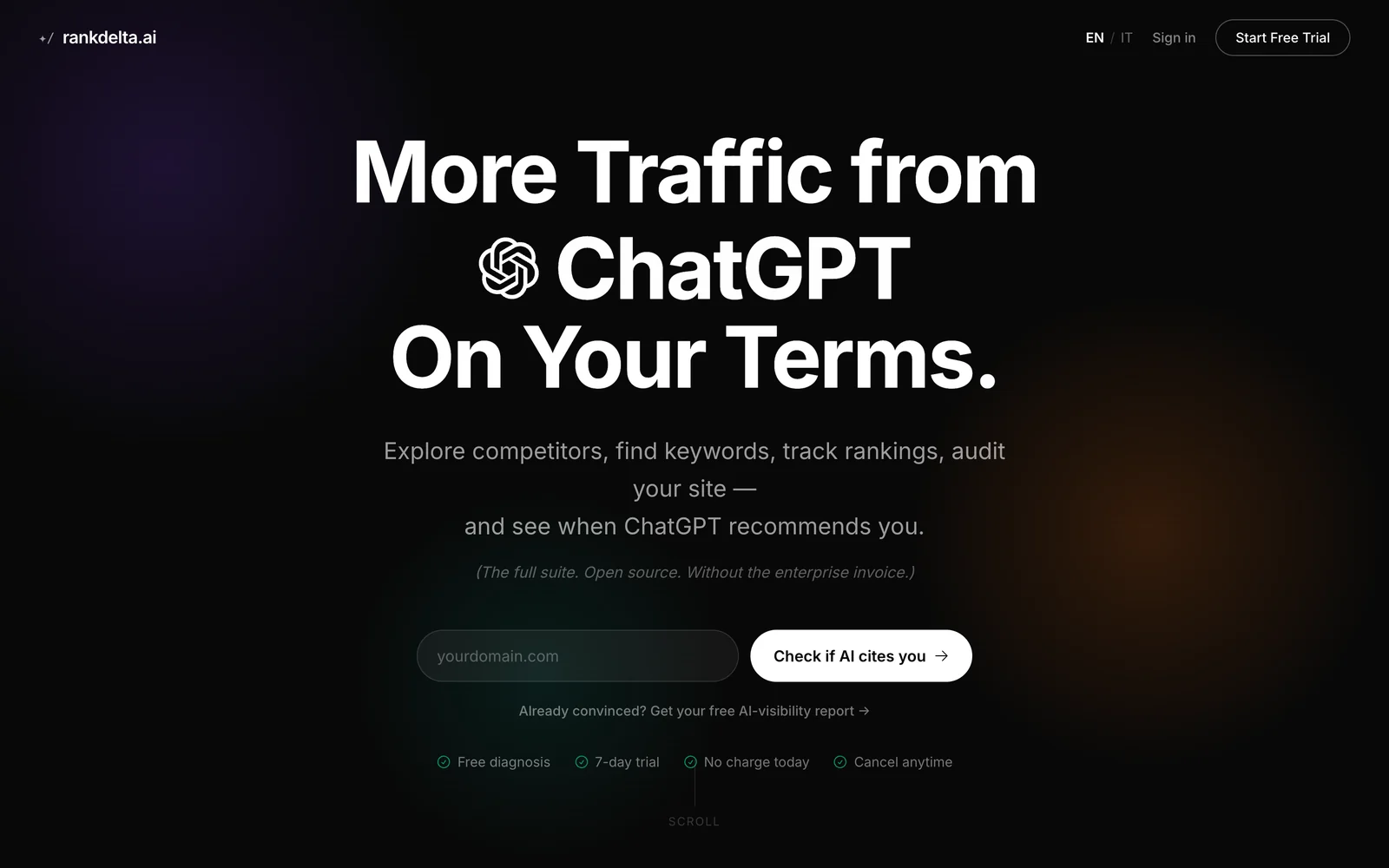
The free check on rankdelta.ai — no signup, one domain, one answer.
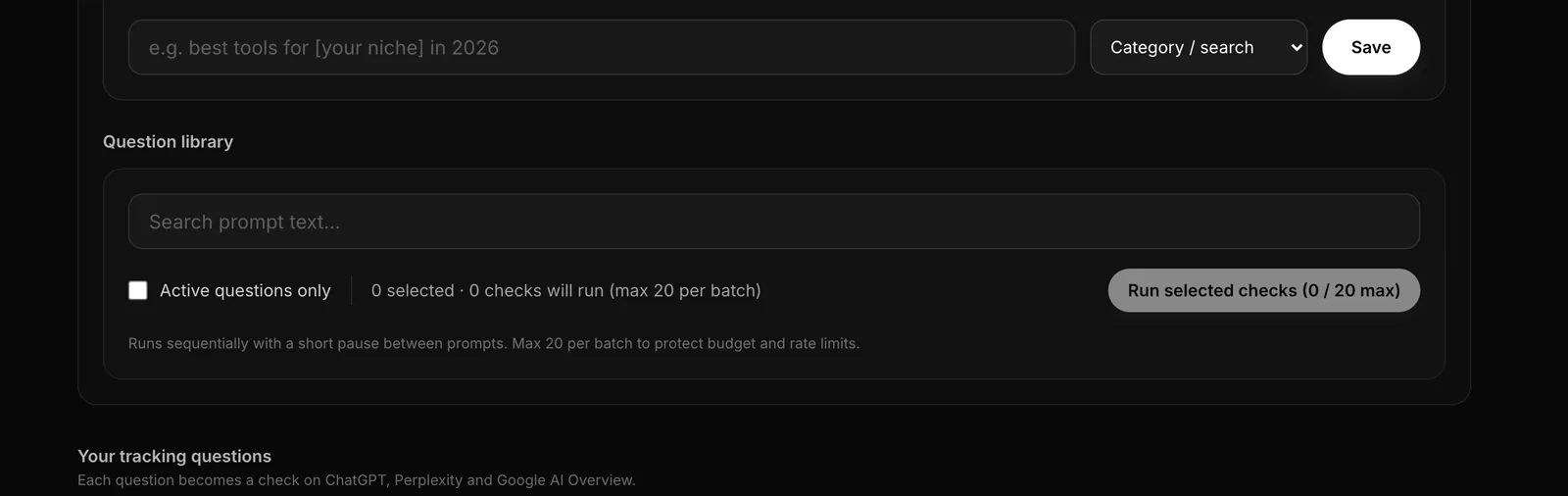
The tracked-prompts view in RankDelta — every buying question becomes a check across the engines, batched to protect the API budget.
Further reading
Start at what AI visibility is, then the tool split in AI visibility tools and how to track AI Overviews. Leaving a bigger name instead? Ahrefs alternative, Semrush alternative, Moz alternative. Own-your-data route: best open source SEO software. Classic-suite SERP: top 10 SEO software. Autopilot writing: /content-agent.
Sources
ubersuggest alternative— low-competition, mid-intent term (estimate; pending an Ahrefs Keywords Explorer pull to confirm exact KD/volume).- Google Search Central — documentation on Search features including AI Overviews and generative-AI reporting.
- Search consensus on "Ubersuggest alternatives" — Ahrefs, Semrush, SE Ranking, Serpstat, AlternativeTo roundups (2026).
- Ahrefs Webmaster Tools — free product for verified owners.